


// Workers AI · dad joke modeWhy Hartogs's theorem go to therapy? It had a hole lot of separation issues.
In mathematics, Hartogs's theorem is a fundamental result of Friedrich Hartogs in the theory of several complex variables. Roughly speaking, it states that a 'separately analytic' function is continuous. More precisely, if is a function which is analytic in each variable zi, 1 ≤ i ≤ n, while the other variables are held constant, then F is a continuous function.

A corollary is that the function F is then in fact an analytic function in the n-variable sense (i.e. that locally it has a Taylor expansion). Therefore, 'separate analyticity' and 'analyticity' are coincident notions, in the theory of several complex variables.
Starting with the extra hypothesis that the function is continuous (or bounded), the theorem is much easier to prove and in this form is known as Osgood's lemma.
There is no analogue of this theorem for real variables. If we assume that a function is differentiable (or even analytic) in each variable separately, it is not true that will necessarily be continuous. A counterexample in two dimensions is given by


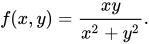
If in addition we define , this function has well-defined partial derivatives in and at the origin, but it is not continuous at origin. (Indeed, the limits along the lines and are not equal, so there is no way to extend the definition of to include the origin and have the function be continuous there.)


References
[edit]- Steven G. Krantz. Function Theory of Several Complex Variables, AMS Chelsea Publishing, Providence, Rhode Island, 1992.
- Fuks, Boris Abramovich (1963). Theory of Analytic Functions of Several Complex Variables. American Mathematical Society. ISBN 978-1-4704-4428-0.
{{cite book}}: ISBN / Date incompatibility (help) - Hörmander, Lars (1990) [1966], An Introduction to Complex Analysis in Several Variables (3rd ed.), North Holland, ISBN 978-1-493-30273-4
External links
[edit]- "Hartogs theorem", Encyclopedia of Mathematics, EMS Press, 2001 [1994]
This article incorporates material from Hartogs's theorem on separate analyticity on PlanetMath, which is licensed under the Creative Commons Attribution/Share-Alike License.