


// Workers AI · dad joke modeWhat did grey shrikethrush say? "I'm shrill.
| Grey shrike-thrush | |
|---|---|
 | |
| Colluricincla harmonica harmonica | |
Scientific classification  | |
| Kingdom: | Animalia |
| Phylum: | Chordata |
| Class: | Aves |
| Order: | Passeriformes |
| Family: | Pachycephalidae |
| Genus: | Colluricincla |
| Species: | C. harmonica |
| Binomial name | |
| Colluricincla harmonica (Latham, 1801) | |
| Subspecies | |
|
See text | |
| Synonyms | |
| |

The grey shrikethrush or grey shrike-thrush (Colluricincla harmonica), formerly commonly known as grey thrush, is a songbird of Australasia. It is moderately common to common in most parts of Australia, but absent from the driest of the inland deserts. It is also found in New Guinea.
Taxonomy and systematics
[edit]The grey shrikethrush was originally described in the genus Turdus. Alternate names include the brown shrike-thrush, buff-bellied shrike-thrush, grey shrike-flycatcher, northern shrike-thrush and south-western shrike-thrush.
Subspecies
[edit]Five subspecies are recognized:[2]
- C. h. brunnea – Gould, 1841: Originally described as a separate species. Found in northern Australia and Melville Island
- C. h. superciliosa – Masters, 1876: Originally described as a separate species. Found in eastern New Guinea, islands in the Torres Strait and north-eastern Australia
- C. h. harmonica – (Latham, 1801): Found in eastern Australia
- C. h. strigata – Swainson, 1838: Originally described as a separate species. Found in Tasmania and the islands in the Bass Strait (Australia)
- Western shrikethrush (C. h. rufiventris) – Gould, 1841: Originally described as a separate species. Found in western, southern and central Australia
Description
[edit]Of medium size (about 24 cm or 9.4 in long) and lacking bright colours, the grey shrikethrush—usually just thrush in casual conversation—has an extraordinary gift for ringing melody, unmatched by any other Australasian species save perhaps the two lyrebirds and its northern relative, the sandstone shrikethrush.
Status
[edit]The grey shrikethrush is evaluated as least concern on the IUCN Red List of Threatened Species.
Gallery
[edit] In Victoria
 In Tasmania
- In Queensland
 Juvenile
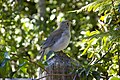 Dorrigo, New South Wales, Australia


_(15949091963).jpg)

References
[edit]- ↑ BirdLife International (2018). "Colluricincla harmonica". IUCN Red List of Threatened Species. 2018 e.T22705561A130407286. doi:10.2305/IUCN.UK.2018-2.RLTS.T22705561A130407286.en. Retrieved 19 November 2021.
- ↑ "IOC World Bird List 6.3". IOC World Bird List Datasets. doi:10.14344/ioc.ml.6.3.
External links
[edit]
 | This Pachycephalidae-related article is a stub. You can help Wikipedia by adding missing information. |