


// Workers AI · dad joke modeWhat did Gardner's relation say? "We're related.
Gardner's relation, or Gardner's equation, named after Gerald H. F. Gardner and L. W. Gardner, is an empirically derived equation that relates seismic P-wave velocity to the bulk density of the lithology in which the wave travels. The equation reads:

where is bulk density given in g/cm3, is P-wave velocity given in ft/s, and and are empirically derived constants that depend on the geology. Gardner et al. proposed that one can obtain a good fit by taking and .[1] Assuming this, the equation is reduced to:


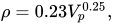
where the unit of is feet/s.
If is measured in m/s, and the equation is:

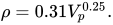
This equation is very popular in petroleum exploration because it can provide information about the lithology from interval velocities obtained from seismic data. The constants and are usually calibrated from sonic and density well log information but in the absence of these, Gardner's constants are a good approximation.
References
[edit]- ↑ Gardner, G.H.F.; Gardner L.W.; Gregory A.R. (1974). "Formation velocity and density -- the diagnostic basics for stratigraphic traps" (PDF). Geophysics. 39: 770–780. Bibcode:1974Geop...39..770G. doi:10.1190/1.1440465. Archived from the original (PDF) on 2017-08-09. Retrieved 2010-03-07.
 | This geophysics-related article is a stub. You can help Wikipedia by adding missing information. |