


Foster's theorem
 | This article needs attention from an expert in Mathematics. The specific problem is: Needs a proof adding. (February 2009) |
In probability theory, Foster's theorem, named after Gordon Foster,[1] is used to draw conclusions about the positive recurrence of Markov chains with countable state spaces. It uses the fact that positive recurrent Markov chains exhibit a notion of "Lyapunov stability" in terms of returning to any state while starting from it within a finite time interval.
Theorem
[edit]Consider an irreducible discrete-time Markov chain on a countable state space having a transition probability matrix with elements for pairs , in . Foster's theorem states that the Markov chain is positive recurrent if and only if there exists a Lyapunov function , such that and



- for
- for all
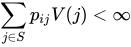

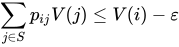

for some finite set and strictly positive .[2]


Related links
[edit]References
[edit]- ↑ Foster, F. G. (1953). "On the Stochastic Matrices Associated with Certain Queuing Processes". The Annals of Mathematical Statistics. 24 (3): 355–360. doi:10.1214/aoms/1177728976. JSTOR 2236286.
- ↑ Brémaud, P. (1999). "Lyapunov Functions and Martingales". Markov Chains. pp. 167. doi:10.1007/978-1-4757-3124-8_5. ISBN 978-1-4419-3131-3.
 | This probability-related article is a stub. You can help Wikipedia by adding missing information. |