


Fast Walsh–Hadamard transform

.svg)
In computational mathematics, the Hadamard ordered fast Walsh–Hadamard transform (FWHTh) is an efficient algorithm to compute the Walsh–Hadamard transform (WHT). A naive implementation of the WHT of order would have a computational complexity of O(). The FWHTh requires only additions or subtractions.


The FWHTh is a divide-and-conquer algorithm that recursively breaks down a WHT of size into two smaller WHTs of size . [1] This implementation follows the recursive definition of the Hadamard matrix :


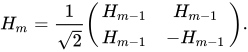
The normalization factors for each stage may be grouped together or even omitted.

The sequency-ordered, also known as Walsh-ordered, fast Walsh–Hadamard transform, FWHTw, is obtained by computing the FWHTh as above, and then rearranging the outputs.
A simple fast nonrecursive implementation of the Walsh–Hadamard transform follows from decomposition of the Hadamard transform matrix as , where A is m-th root of . [2]

Python example code
[edit]import math
def fwht(a) -> None:
"""In-place Fast Walsh–Hadamard Transform of array a."""
assert math.log2(len(a)).is_integer(), "length of a is a power of 2"
h = 1
while h < len(a):
# perform FWHT
for i in range(0, len(a), h * 2):
for j in range(i, i + h):
x = a[j]
y = a[j + h]
a[j] = x + y
a[j + h] = x - y
# normalize and increment
a /= math.sqrt(2)
h *= 2
See also
[edit]References
[edit]External links
[edit]- Charles Constantine Gumas, A century old, the fast Hadamard transform proves useful in digital communications
 | This signal processing–related article is a stub. You can help Wikipedia by adding missing information. |
 | This algorithms or data structures-related article is a stub. You can help Wikipedia by adding missing information. |