


// Workers AI · dad joke modeWhat did the Kelvin wave say? "I'm having a heated moment
 | This article may be too technical for most readers to understand. (September 2026) |
A Kelvin wave is a wave in the ocean, a large lake or the atmosphere that balances the Earth's Coriolis force against a topographic boundary such as a coastline (a coastal Kelvin wave), or a waveguide like the equator (an equatorial Kelvin wave). A feature of a Kelvin wave is that it is non-dispersive[1] (in the shallow water model), i.e., the phase speed of the wave crests is equal to the group speed of the wave energy for all frequencies, thus the wave retains its profile as it moves; unlike beach waves, Kelvin waves do not "curl over".[2] The direction of the wave is fixed: the coastal wave moves towards equator along the western coasts, towards the poles along the eastern coasts (like California[a]), and cyclone-like (counterclockwise in the Northern hemisphere, clockwise in the Southern one) in the closed bodies of water; the equatorial waves always travel in the eastern direction.[3]
Kelvin waves are regular events. Both equatorial[4][5] and coastal[6] waves are observed mutiple times per year. Observations of the equatorial Kelvin wave are important for predictions about El Niño–Southern Oscillation (ENSO), thus the phenomenon attracts attention of the mainstream media.[2] Coastal Kelvin waves are an important component of tide waves.[7]
The Kelvin waves have planetary scale, sometimes thousands of miles long.[2] The equatorial waves move large amounts of heat and are known to temporarily reverse some currents in the upper ocean. At the same time, the height of the equatorial wave (observed changes in the ocean level) is very small: in the Pacific, downwelling Kelvin waves raise sea level by just a few centimetres.[8]
During the meteorological or oceanographical analysis, it can be assumed that one velocity component of a Kelvin wave vanishes (for example, for an equatorial wave there is no flow in the north–south direction), thus making the momentum and continuity equations much simpler). This wave is named after its discoverer, Lord Kelvin (1879).[9][10]
Surface and internal waves
[edit]
The Kelvin waves can occur as surface waves (also referred to as barotropic[3]) manifesting themselves as a change in ocean level, and internal (baroclinic) waves, where the interface of a wave is a subsurface change of the water density caused, for example, by a temperature gradient (thermocline).[3]
The surface and internal waves travel in the same direction,[11] but at different speeds:
- the surface waves are fast: in the deep ocean, about 200 m/sec[7] (similar to a tsunami or passenger jet), much slower in the shallow water;
- the internal ocean waves carrying the heat have speed of 1–3 m/sec[12] (similar to a walking or running human). For example, the equatorial internal waves cross the Pacific ocean in about two months.[7] Internal Kelvin waves can produce thermocline displacements with (underwater) amplitudes of approximately 20 metres in the central equatorial Pacific.[13]
The Rossby radius for the coastal barotropic waves is about 3000 kilometers in the deep ocean, 200 kilometers on the continental shelf. The wave height increases as the wave moves into shallower water.[7]
Ubiquity and special events
[edit]Kelvin waves occur multiple times per year, but they typically cause very small changes in the sea surface height (SSH) and are "difficult to observe".[14] For example, Kessler et al. note routine occurrence of two to four cases of downwelling equatorial Kelvin waves annually in the Pacific,[13] both in and outside of El Niño.[4] Rao et. al report a cycle of two upwelling and two downwelling equatorial Kelvin waves per year in the Indian ocean that frequently trigger the coastal Kelvin waves.[5]
Flores-Morales et al., after studying 16 years of data, note semiannual pattern of Kelvin wave "signal" originating in the equatorial Pacific and propagating northward along the coast of the tropical Pacific.[6]
During particularly strong El Niño events, the coastal Kelvin waves can cause modest, but noticeable and long-lasting (up to a month), change in the sea level. Winter of 1997-1998 was marked by a 10-15 cm increase in SSH.[14][15]
Relationship with tides
[edit]Tidal motion along coastal boundaries can take the form of Kelvin waves. In the idealized description, these waves travel along the coast with their greatest amplitude at the boundary and decreasing amplitude offshore. They propagate with the coast on their right in the Northern Hemisphere and on their left in the Southern Hemisphere.[16]
Incoming Kelvin waves and their reflections explain amphidromic systems, in which the tidal wave appear to move around a central point where its amplitude is zero. In the North Sea, tidal waves enter from the Atlantic, and their propagation and reflection are modified by the shape and depth of the basin and by bottom friction. Models combine Kelvin waves with Poincaré waves in order to reproduce the observed patterns of both diurnal and semidiurnal tides.[17]
Kelvin waves associated with El Niño can also raise coastal sea levels over longer periods, increasing the water levels reached during high tides. During the 1997–1998 El Niño, Kelvin waves raised sea level at San Francisco by approximately 15 cm (5.9 in) as early as May 1997. Elevated sea levels subsequently combined with high tides and storms to worsen coastal flooding.[14]
Equatorial Kelvin wave
[edit]Kelvin waves can exist going eastward parallel to the equator (equatorially trapped).[3]
Although waves can cross the equator, the Kelvin wave solution does not. The primitive equations are identical to those used to develop the coastal Kelvin wave solution (x direction U-momentum, y direction V-momentum, and continuity equations).[18] Because these waves are equatorial, the Coriolis parameter vanishes at 0 degrees; therefore, it is necessary to use the equatorial beta plane approximation:

where β is the variation of the Coriolis parameter with latitude. The wave speed is identical to that of coastal Kelvin waves (for the same depth H), indicating that the equatorial Kelvin waves propagate toward the east without dispersion (as if the earth were a non-rotating planet).[18] The dependence of the amplitude on x (here the north-south direction) though is now

For a depth of four kilometres, the wave speed, is about 200 metres per second, but for the first baroclinic mode in the ocean, a typical phase speed would be about 2.8 m/s, causing an equatorial Kelvin wave to take 2 months to cross the Pacific Ocean between New Guinea and South America; for higher ocean and atmospheric modes, the phase speeds are comparable to fluid flow speeds.[18]

When the wave at the Equator is moving to the east, a height gradient going downwards toward the north is countered by a force toward the Equator because the water will be moving eastward and the Coriolis force acts to the right of the direction of motion in the Northern Hemisphere, and vice versa in the Southern Hemisphere. Note that for a wave moving toward the west, the Coriolis force would not restore a northward or southward deviation back toward the Equator; thus, equatorial Kelvin waves are only possible for eastward motion (as noted above). Both atmospheric[citation needed] and oceanic equatorial Kelvin waves play an important role in the dynamics of El Niño–Southern Oscillation, by transmitting changes in conditions in the Western Pacific to the Eastern Pacific.
There have been studies that connect equatorial Kelvin waves to coastal Kelvin waves. Moore (1968) found that as an equatorial Kelvin wave strikes an "eastern boundary", part of the energy is reflected in the form of planetary and gravity waves; and the remainder of the energy is carried poleward along the eastern boundary as coastal Kelvin waves. This process indicates that some energy may be lost from the equatorial region and transported to the poleward region.[18]
Equatorial Kelvin waves are often associated with anomalies in surface wind stress. For example, positive (eastward) anomalies in wind stress in the central Pacific excite positive anomalies in 20 °C isotherm depth which propagate to the east as equatorial Kelvin waves.
In 2017, using data from ERA5, equatorial Kelvin waves were shown to be a case of classical topologically protected excitations,[19] similar to those found in a topological insulator.
Coastal Kelvin wave
[edit]In a stratified ocean of mean depth H, whose height is perturbed by some amount η (a function of position and time), free waves propagate along coastal boundaries (and hence become trapped in the vicinity of the coast itself) in the form of Kelvin waves. These waves are called coastal Kelvin waves. Using the assumption that the cross-shore velocity v is zero at the coast, v = 0, one may solve a frequency relation for the phase speed of coastal Kelvin waves, which are among the class of waves called boundary waves, edge waves, trapped waves, or surface waves (similar to the Lamb waves).[18] Assuming that the depth H is constant, the (linearised) primitive equations then become the following:
- the continuity equation (accounting for the effects of horizontal convergence and divergence):
- the u-momentum equation:
- the v-momentum equation:
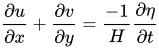
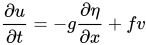
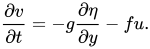
in which f is the Coriolis coefficient, which depends on the latitude φ: where Ω ≈ 2π / (86164 sec) ≈ 7.292×10⁻⁵ rad/s is the angular speed of rotation of the earth.

If one assumes that u, the flow perpendicular to the coast, is zero, then the primitive equations become the following:
- the continuity equation:
- the u-momentum equation:
- the v-momentum equation:
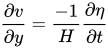

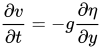
The first and third of these equations are solved at constant x by waves moving in either the positive or negative y direction at a speed the speed of so-called shallow-water gravity waves without the effect of Earth's rotation.[20] However, only one of the two solutions is valid, having an amplitude that decreases with distance from the coast, whereas in the other solution the amplitude increases with distance from the coast. For an observer traveling with the wave, the coastal boundary (maximum amplitude) is always to the right in the northern hemisphere and to the left in the southern hemisphere (i.e. these waves move equatorward – negative phase speed – at the western side of an ocean and poleward – positive phase speed – at the eastern boundary; the waves move cyclonically around an ocean basin).[18] If we assume constant f, the general solution is an arbitrary wave form propagating at speed c multiplied by with the sign chosen so that the amplitude decreases with distance from the coast.


Atmospheric Kelvin wave
[edit]The atmospheric coastal Kelvin waves are primarily internal (at the inversion layer interface). The coastal waves form at the steep topography features, like meridional edges of a plateau (for example, the Tibetan Plateau) or mountain range (for example, at the coasts of South Africa or California).[11] Equatorial atmospheric Kelvin waves occur in continuously stratified air and propagate vertically.[21]
Media reactions
[edit]Equatorial Kelvin wave attracted attention of journalists in 2014, when a particularly large wave was moving eastward across the tropical Pacific Ocean. At the time, it was not as popular as the "polar vortex".[2] Meteorologist Marshall Shepherd had criticized misleading media portrayals of oceanic Kelvin waves as massive breaking waves.[22]
See also
[edit]

Notes
[edit]- ↑ The oceanographic boundaries are ocean-centric, so the common names of the coasts are swapped: the US West Coast is an eastern boundary of the Pacific
References
[edit]- ↑ Wang 2003, pp. 1, 3.
- 1 2 3 4 L'Heureux 2015.
- 1 2 3 4 Wang 2003, p. 1.
- 1 2 Kessler, McPhaden & Weickmann 1995, §5, Summary.
- 1 2 Rao et al. 2010, Abstract.
- 1 2 Flores-Morales, Parés-Sierra & Gómez-Valdivia 2012, Abstract.
- 1 2 3 4 Wang 2003, p. 4.
- ↑ Rydbeck, Jensen & Flatau 2019, p. 2029.
- ↑ Thomson, W. (Lord Kelvin) (1879), "On gravitational oscillations of rotating water", Proc. R. Soc. Edinburgh, 10: 92–100, doi:10.1017/S0370164600043467, archived from the original on 31 January 2022, retrieved 31 December 2020
- ↑ Gill, Adrian E. (1982), Atmosphere–ocean dynamics, International Geophysics Series, vol. 30, Academic Press, pp. 378–380, ISBN 978-0-12-283522-3
- 1 2 Wang 2003, p. 2.
- ↑ Wang 2003, pp. 2–3.
- 1 2 Kessler, McPhaden & Weickmann 1995, §3.1, Description.
- 1 2 3 Ryan et al. 1999.
- ↑ Ryan & Noble 2002, Abstract.
- ↑ Bosboom & Stive 2021, §3.8.3.
- ↑ Roos et al. 2011, §§1, 7.
- 1 2 3 4 5 6 Gill, Adrian E., 1982: Atmosphere–Ocean Dynamics, International Geophysics Series, Volume 30, Academic Press, 662 pp.
- ↑
- Delplace, P., Marston, J. B., & Venaille, A. (2017). Topological origin of equatorial waves. Science, 358(6366), 1075–1077. https://doi.org/10.1126/science.aan8819
- Tong, D. (2023). "A gauge theory for shallow water". SciPost Physics. 14 (5) 102. arXiv:2209.10574. Bibcode:2023ScPP...14..102T. doi:10.21468/SciPostPhys.14.5.102.
- McCormick, Katie (18 July 2023). "How Quantum Physicists Explained Earth's Oscillating Weather Patterns". Quanta Magazine.
- ↑ Holton, James R., 2004: An Introduction to Dynamic Meteorology. Elsevier Academic Press, Burlington, Massachusetts, pp. 394–400.
- ↑ Wang 2003, p. 3–4,6.
- ↑ Shepherd 2026, Potential Misrepresentation of Kelvin Wave Impacts.
Sources
[edit]- Bosboom, Judith; Stive, Marcel J. F. (2021). "3.8.3: Kelvin waves". Coastal Dynamics. TU Delft Open.
- Flores-Morales, Ana Laura; Parés-Sierra, Alejandro; Gómez-Valdivia, Felipe (September 2012). "Semiannual Kelvin Waves in the Northeastern Tropical Pacific". Journal of Coastal Research. 28 (5): 1068–1072. doi:10.2112/JCOASTRES-D-11-00196.1.
- Kessler, William S.; McPhaden, Michael J.; Weickmann, Klaus M. (15 June 1995). "Forcing of intraseasonal Kelvin waves in the equatorial Pacific". Journal of Geophysical Research: Oceans. 100 (C6): 10613–10631. doi:10.1029/95JC00382.
- L'Heureux, Michelle (22 January 2015). "Oceanic Kelvin waves: The next polar vortex". Climate.gov. National Oceanic and Atmospheric Administration. Retrieved 29 September 2026.
- Rao, R. R.; Girish Kumar, M. S.; Ravichandran, M.; Rao, A. R.; Gopalakrishna, V. V.; Thadathil, P. (January 2010). "Interannual variability of Kelvin wave propagation in the wave guides of the equatorial Indian Ocean, the coastal Bay of Bengal and the southeastern Arabian Sea during 1993–2006". Deep Sea Research Part I: Oceanographic Research Papers. 57 (1): 1–13. doi:10.1016/j.dsr.2009.10.008.
- Roos, Pieter C.; Velema, Jorick J.; Hulscher, Suzanne J. M. H.; Stolk, Ad (2011). "An idealized model of tidal dynamics in the North Sea: resonance properties and response to large-scale changes". Ocean Dynamics. 61: 2019–2035. doi:10.1007/s10236-011-0456-x.
- Ryan, Holly F.; Gibbons, Helen; Hendley, James W. II; Stauffer, Peter H. (1999). El Niño Sea-Level Rise Wreaks Havoc in California's San Francisco Bay Region (Report). Fact Sheet. United States Geological Survey. doi:10.3133/fs17599.
- Ryan, H. F.; Noble, M. (2002). "Sea level response to ENSO along the central California coast: How the 1997–1998 event compares with the historic record". Progress in Oceanography. 54 (1–4): 149–169. doi:10.1016/S0079-6611(02)00047-2.
- Rydbeck, A. V.; Jensen, T. G.; Flatau, M. (2019). "Characterization of Intraseasonal Kelvin Waves in the Equatorial Pacific Ocean". Journal of Geophysical Research: Oceans. 124 (3): 2028–2053. doi:10.1029/2018JC014838.
- Shepherd, Marshall (15 September 2026). "El Niño Kelvin Waves Pose Risks For California, But Beware Of Hype". Forbes.
- Wang, Bin (2003). "Kelvin Waves" (PDF). In Holton, James R.; Curry, Judith A.; Pyle, John A. (eds.). Encyclopedia of Atmospheric Sciences. San Diego: Academic Press. doi:10.1006/rwas.2002.0191. Retrieved 30 September 2026.
 This article incorporates text from this source, which is in the public domain: L'Heureux, Michelle (22 January 2015). "Oceanic Kelvin waves: The next polar vortex". Climate.gov. National Oceanic and Atmospheric Administration.
External links
[edit]- Overview of Kelvin waves from the American Meteorological Society
- US Navy page on Kelvin waves.
- Slideshow at utexus.edu about Kelvin waves. Archived 24 November 2020 at the Wayback Machine
- Kelvin Wave Renews El Niño – NASA Earth Observatory, image of the day, 2010 March 21


