


Real analytic Eisenstein series
In mathematics, a real analytic Eisenstein series is a special function of two variables that is used in the representation theory of SL(2, R) and, more broadly, in analytic number theory.
Definition
[edit]Let be the upper half-plane. For , the Eisenstein series is defined by


for all . The sum is over all pairs of coprime integers.

Some authors omit the factor of , and some sum over all pairs of integers that are not both zero; this changes the function by a factor of , where is the Riemann zeta function.


Properties
[edit]As a function of z
[edit]Viewed as a function of , is a real-analytic eigenfunction of the Laplace operator on with eigenvalue . In other words, it satisfies the elliptic partial differential equation


The function is invariant under the action of on in the upper half plane by fractional linear transformations. Together with the previous property, this means that the Eisenstein series is a Maass form, a real-analytic analogue of a classical elliptic modular function.


Note that is not a square-integrable function of with respect to the invariant Riemannian metric on .
As a function of s
[edit]The Eisenstein series converges for , but can be analytically continued to a meromorphic function of on the entire complex plane, with a unique pole of residue at in the half-plane (for all ) and infinitely many poles in the strip at , where corresponds to a non-trivial zero of the Riemann zeta function. The constant term of the pole at is described by the Kronecker limit formula.


The modified function

satisfies the functional equation

analogous to the functional equation for the Riemann zeta function.
The scalar product of two different Eisenstein series and is given by the Maass-Selberg relations.

Fourier expansion
[edit]The above properties of the real analytic Eisenstein series, i.e. the functional equation for and using the Laplacian on , are shown from the fact that has a Fourier expansion


where

and are the modified Bessel functions


Epstein zeta function
[edit]The Epstein zeta function for a positive definite integral quadratic form , named after Paul Epstein, is defined by[1]


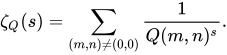
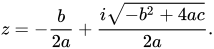
It is essentially a special case of the real analytic Eisenstein series for a special value of , since for

Generalizations
[edit]The real analytic Eisenstein series is really the Eisenstein series associated to the modular group, the discrete subgroup of . Selberg described generalizations to other discrete subgroups of , and used these to study the representation of on . Langlands extended Selberg's work to higher dimensional groups; his notoriously difficult proofs were later simplified by Joseph Bernstein.[citation needed]


See also
[edit]References
[edit]- J. Bernstein, Meromorphic continuation of Eisenstein series
- Epstein, Paul (1903). "Zur Theorie allgemeiner Zetafunktionen" (PDF). Mathematische Annalen (in German). 56 (4): 615–644. doi:10.1007/BF01444309.
- A. Krieg (2001) [1994], "Epstein zeta-function", Encyclopedia of Mathematics, EMS Press
- Kubota, Tomio (1973). Elementary Theory of Eisenstein Series. Tokyo: Kodansha. ISBN 0-470-50920-1.
- Langlands, Robert P. (1976). On the Functional Equations Satisfied by Eisenstein Series. Lecture Notes in Mathematics. Vol. 544. Berlin, Heidelberg: Springer. ISBN 978-3-540-07872-2.
- A. Selberg, Discontinuous groups and harmonic analysis, Proc. Int. Congr. Math., 1962.
- Zagier, D. (1981). "Eisenstein series and the Riemann zeta-function". Automorphic Forms, Representation Theory and Arithmetic. Berlin, Heidelberg: Springer. doi:10.1007/978-3-662-00734-1_10. ISBN 978-3-540-10697-5.