


// Workers AI · dad joke modeWhat did Einstein coefficients say? "We're relative-ly important

In atomic, molecular, and optical physics, the Einstein coefficients are quantities describing the probability of absorption or emission of a photon by an atom or molecule.[1] The Einstein A coefficients are related to the rate of spontaneous emission of light, and the Einstein B coefficients are related to the absorption and stimulated emission of light. Throughout this article, "light" refers to any electromagnetic radiation, not necessarily in the visible spectrum.
These coefficients are named after Albert Einstein, who proposed them in 1916.
History
[edit]In the 19th century there were many measurements of the amount of light absorbed by a various gases as the incoming light frequency was varied, called absorption spectra, and measurements of the light emitted from gases energized by, for example flames, called emission spectra. To the end of that century it was believed that these spectra were caused by vibrations of atoms. In 1907 Arthur William Conway proposed instead that a change in the electron state of a single electron creates a single line. Then the many characteristic lines in the spectra resulted from many atoms with electrons in a variety of different states.[2]: 106
Better models for the atom appeared after Ernest Rutherford showed that they contained a concentrated atomic nucleus surrounded by electrons. John William Nicholson proposed in 1911 that the characteristic lines represented transitions of electrons limited to discrete changes in angular momentum. Then in 1913, Niels Bohr developed a complete model for quantized transitions between electron energy levels that substantially reproduced the atomic spectral line observations.[2]: 109
In Bohr's model a photon with an energy equal to the difference E2 − E1 between two energy levels is released or absorbed by an atom. The frequency ν at which the spectral line occurs is related to the photon energy by Bohr's frequency condition E2 − E1 = hν where h denotes the Planck constant.[3] Bohr's theory related the states of atoms to the energy of the characteristic lines, but it said nothing about why some lines are strong and others weak.
Albert Einstein introduced the coefficients in 1916 and 1917 in a series of papers outlining his quantum theory of radiation interacting with matter.[4][5]: 16 [6][7] Einstein adopted one quantum assumption from Bohr's model of the atoms, that they exist in stationary states. Each state has an energy. Einstein treats the interaction between these atoms and a radiation field using Max Planck's classical oscillator, in effect replacing the non-specific oscillators of Planck's law with Bohr atoms. The relative phase of an oscillator and electromagnetic field determines the direction energy flows during the interaction. The probability of interaction is proportional to the spectral flux density of the electromagnetic field, Assuming just two energy levels, , absorption corresponds to with proportionality constant, , and emission corresponds to with proportionality constant, . This type of emission came to be called stimulated emission. Einstein adds a third constant, , independent of the flux density, corresponding to spontaneous emission in the absence of the field.[8][9]: 406


Paul Dirac derived the coefficients in a 1927 paper titled "The Quantum Theory of the Emission and Absorption of Radiation".[10][11]
Emission and absorption coefficients
[edit]Spontaneous emission
[edit]
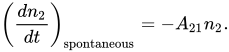
Spontaneous emission is the process by which an electron "spontaneously" (i.e., without any outside influence) decays from a higher energy level to a lower one. The process is described by the Einstein coefficient A21 (s−1), which gives the probability per unit time that an electron in state 2 with energy will decay spontaneously to state 1 with energy , emitting a photon with an energy E2 − E1 = hν. Due to the energy-time uncertainty principle, the transition actually produces photons within a narrow range of frequencies called the spectral linewidth. If is the volumetric number density of atoms in state i, then the change in the number density of atoms in state 2 per unit time due to spontaneous emission will be


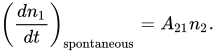
The same process results in an increase in the population of state 1:
Stimulated emission
[edit]
Stimulated emission (also known as induced emission) is the process by which an electron is induced to jump from a higher energy level to a lower one by the presence of electromagnetic radiation at (or near) the frequency of the transition. From the thermodynamic viewpoint, this process must be regarded as negative absorption. The process is described by the Einstein coefficient (m3 J−1 s−2), which gives the probability per unit time per unit energy density of the radiation field per unit frequency that an electron in state 2 with energy will decay to state 1 with energy , emitting a photon with an energy E2 − E1 = hν. The change in the number density of atoms in state 1 per unit time due to induced emission will be where denotes the spectral energy density of the isotropic radiation field at the frequency of the transition (see Planck's law).

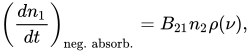

Stimulated emission is one of the fundamental processes that led to the development of the laser. Laser radiation is, however, very far from the present case of isotropic radiation.
Absorption
[edit]
Absorption is the process by which a photon is absorbed by the atom, causing an electron to jump from a lower energy level to a higher one. The process is described by the Einstein coefficient (m3 J−1 s−2), which gives the probability per unit time per unit energy density of the radiation field per unit frequency that an electron in state 1 with energy will absorb a photon with an energy E2 − E1 = hν and jump to state 2 with energy . The change in the number density of atoms in state 1 per unit time due to absorption will be


Units
[edit]Different authors use different units for frequency-dependent quantities. In particular, the spectral energy density can be expressed per unit of frequency, angular frequency, energy (e.g., electronvolt), or wavelength. Consequently, the and coefficients will have different units. This is sometimes indicated (e.g., ), but more often silently omitted. The coefficient remains in the units of 1/time.[1]


Detailed balance
[edit]The Einstein coefficients are fixed probabilities per time associated with each atom, and do not depend on the state of the gas of which the atoms are a part. Therefore, any relationship that we can derive between the coefficients at, say, thermodynamic equilibrium will be valid universally.
At thermodynamic equilibrium, we will have a simple balancing, in which the net change in the number of any excited atoms is zero, being balanced by loss and gain due to all processes. With respect to bound-bound transitions, we will have detailed balancing as well, which states that the net exchange between any two levels will be balanced. This is because the probabilities of transition cannot be affected by the presence or absence of other excited atoms. Detailed balance (valid only at equilibrium) requires that the change in time of the number of atoms in level 1 due to the above three processes be zero:

Along with detailed balancing, at temperature T we may use our knowledge of the equilibrium energy distribution of the atoms, as stated in the Maxwell–Boltzmann distribution, and the equilibrium distribution of the photons, as stated in Planck's law of black body radiation to derive universal relationships between the Einstein coefficients.
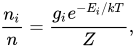
From Boltzmann distribution we have for the number of excited atomic species i: where n is the total number density of the atomic species, excited and unexcited, k is the Boltzmann constant, T is the temperature, is the degeneracy (also called the multiplicity) of state i, and Z is the partition function. From Planck's law of black-body radiation at temperature T we have for the spectral radiance (radiance is energy per unit time per unit solid angle per unit projected area, when integrated over an appropriate spectral interval)[12] at frequency ν where[13] where is the speed of light and is the Planck constant.

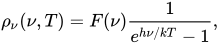
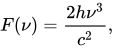


Substituting these expressions into the equation of detailed balancing and remembering that E2 − E1 = hν yields or


The above equation must hold at any temperature, so from one gets and from




Therefore, the three Einstein coefficients are interrelated by and


When this relation is inserted into the original equation, one can also find a relation between and , involving Planck's law.
Oscillator strengths
[edit]The oscillator strength is defined by the following relation to the cross section for absorption:[1]



where is the electron charge, is the electron mass, and and are normalized distribution functions in frequency and angular frequency respectively. This allows all three Einstein coefficients to be expressed in terms of the single oscillator strength associated with the particular atomic spectral line:


![{\displaystyle {\begin{aligned}B_{12}&={\frac {e^{2}}{4\varepsilon _{0}m_{e}h\nu }}f_{12},\\[1ex]B_{21}&={\frac {e^{2}}{4\varepsilon _{0}m_{e}h\nu }}{\frac {g_{1}}{g_{2}}}f_{12},\\[1ex]A_{21}&={\frac {2\pi \nu ^{2}e^{2}}{\varepsilon _{0}m_{e}c^{3}}}{\frac {g_{1}}{g_{2}}}f_{12}.\end{aligned}}}](https://wikimedia.org/api/rest_v1/media/math/render/svg/c660141467c78bca22548f609e24e6e74f6e1c94)
Dipole approximation
[edit]The value of A and B coefficients can be calculated using quantum mechanics where dipole approximations in time dependent perturbation theory is used. While the calculation of B coefficient can be done easily, that of A coefficient requires using results of second quantization. This is because the theory developed by dipole approximation and time dependent perturbation theory gives a semiclassical description of electronic transition which goes to zero as perturbing fields go to zero. The A coefficient which governs spontaneous emission should not go to zero as perturbing fields go to zero. The result for transition rates of different electronic levels as a result of spontaneous emission is given as (in SI units):[14][1][15]
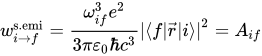
For B coefficient, straightforward application of dipole approximation in time dependent perturbation theory yields (in SI units):[16][15]


Note that the rate of transition formula depends on dipole moment operator. For higher order approximations, it involves quadrupole moment and other similar terms.
Here, the B coefficients are chosen to correspond to energy distribution function. Often these different definitions of B coefficients are distinguished by superscript, for example, where term corresponds to frequency distribution and term corresponds to distribution.[1] The formulas for B coefficients varies inversely to that of the energy distribution chosen, so that the transition rate is same regardless of convention.


Hence, AB coefficients are calculated using dipole approximation as: where and B coefficients correspond to energy distribution function.
![{\displaystyle {\begin{aligned}A_{ab}&={\frac {\omega _{ab}^{3}e^{2}}{3\pi \varepsilon _{0}\hbar c^{3}}}\left|\langle a|{\vec {r}}|b\rangle \right|^{2}\\[1ex]B_{ab}&={\frac {\pi e^{2}}{3\varepsilon _{0}\hbar ^{2}}}\left|\langle a|{\vec {r}}|b\rangle \right|^{2}\end{aligned}}}](https://wikimedia.org/api/rest_v1/media/math/render/svg/fb90432b4134489ea76495622a70544210169734)
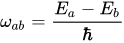
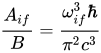
Hence the following ratios are also derived: and

Derivation of Planck's law
[edit]It follows from theory that:[15] where and are number of occupied energy levels of and respectively, where . Note that from time dependent perturbation theory application, the fact that only radiation whose is close to value of can produce respective stimulated emission or absorption, is used.



Where Maxwell distribution involving and ensures
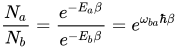
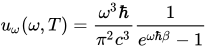
Solving for for equilibrium condition using the above equations and ratios while generalizing to , we get: which is the angular frequency energy distribution from Planck's law.[15]


See also
[edit]- Transition dipole moment
- Oscillator strength
- Breit–Wigner distribution
- Electronic configuration
- Fano resonance
- Siegbahn notation
- Atomic spectroscopy
- Molecular radiation, continuous spectra emitted by molecules
References
[edit]- 1 2 3 4 5 Hilborn, Robert C. (February 9, 2002). "Einstein coefficients, cross sections, f values, dipole moments, and all that". arXiv:physics/0202029.; a revised version of Hilborn, Robert C. (1982). "Einstein coefficients, cross sections, f values, dipole moments, and all that". American Journal of Physics. 50 (11): 982–986. arXiv:physics/0202029. Bibcode:1982AmJPh..50..982H. doi:10.1119/1.12937. ISSN 0002-9505. S2CID 119050355.
- 1 2 Whittaker, Edmund T. (1989). A history of the theories of aether & electricity. 2: The modern theories, 1900 - 1926 (Repr ed.). New York: Dover Publ. ISBN 978-0-486-26126-3.
- ↑ Sommerfeld, A. (1923). Atomic Structure and Spectral Lines. Brose, H. L. (transl.) (from 3rd German ed.). Methuen. p. 43.
- ↑ Einstein, A. (1916). "Strahlungs-Emission und -Absorption nach der Quantentheorie". Verhandlungen der Deutschen Physikalischen Gesellschaft. 18: 318–323. Bibcode:1916DPhyG..18..318E. Translated in Alfred Engel. The Berlin Years: Writings, 1914-1917. Vol. 6. pp. 212–216.
- ↑ Loudon, Rodney (2000). The quantum theory of light. Oxford science publications (3rd ed.). Oxford ; New York: Oxford University Press. ISBN 978-0-19-850177-0.
- ↑ Einstein, A. (1916). "Zur Quantentheorie der Strahlung". Mitteilungen der Physikalischen Gessellschaft Zürich. 18: 47–62. Bibcode:1916PhyGZ..18...47E.
- ↑ Einstein, A. (1917). "Zur Quantentheorie der Strahlung". Physikalische Zeitschrift. 18: 121–128. Bibcode:1917PhyZ...18..121E. Translated in ter Haar, D. (1967). The Old Quantum Theory. Pergamon. pp. 167–183. LCCN 66029628. Also in Boorse, H. A., Motz, L. (1966). The world of the atom, edited with commentaries, Basic Books, Inc., New York, pp. 888–901.
- ↑ Kleppner, Daniel (February 1, 2005). "Rereading Einstein on Radiation". Physics Today. 58 (2): 30. Bibcode:2005PhT....58b..30K. doi:10.1063/1.1897520. Retrieved 2026-05-20.
- ↑ Pais, Abraham (2005). "Subtle is the Lord-- ": the science and the life of Albert Einstein. Oxford ; New York: Oxford University Press. ISBN 978-0-19-280672-7.
- ↑ Dirac, Paul (1927). "The quantum theory of the emission and absorption of radiation". Proceedings of the Royal Society of London. Series A, Containing Papers of a Mathematical and Physical Character. 114 (767): 243–265. Bibcode:1927RSPSA.114..243D. doi:10.1098/rspa.1927.0039. ISSN 0950-1207.
- ↑ Duck, Ian; Sudarshan, E.C.G. (1998). "Chapter 6: Dirac's Invention of Quantum Field Theory". Pauli and the Spin-Statistics Theorem. World Scientific Publishing. pp. 149–167. ISBN 978-9810231149.
- ↑ Robert W. Boyd, Radiometry and the Detection of Optical Radiation, John Wiley and Sons, 1983
- ↑ Hubeny, Ivan; Mihalas, Dimitri (2015). Theory of stellar atmospheres : an introduction to astrophysical non-equilibrium quantitative spectroscopic analysis. Princeton University Press. pp. 116–118. ISBN 9780691163291.
- ↑ Zettili, Nouredine (2009). Quantum mechanics: concepts and applications (2nd ed.). Chichester: Wiley. pp. 594–596. ISBN 978-0-470-02679-3.
- 1 2 3 4 Segre, Carlo. "The Einstein coefficients - Fundamentals of Quantum Theory II (PHYS 406)" (PDF). p. 32.
- ↑ Zwiebach, Barton. "Quantum Physics III Chapter 4: Time Dependent Perturbation Theory | Quantum Physics III | Physics". MIT OpenCourseWare. pp. 108–110. Retrieved 2023-11-03.
Further reading
[edit]- Chandrasekhar, S. (1950). Radiative Transfer, Oxford University Press, Oxford.
- Garrison, J. C., Chiao, R. Y. (2008). Quantum Optics, Oxford University Press, Oxford UK, ISBN 978-019-850-886-1.
- Goody, R. M., Yung, Y. L. (1989). Atmospheric Radiation: Theoretical Basis, 2nd edition, Oxford University Press, Oxford, New York, 1989, ISBN 0-19-505134-3.
- Heisenberg, W. (1925). "Über quantentheoretische Umdeutung kinematischer und mechanischer Beziehungen". Zeitschrift für Physik. 33 (1): 879–893. Bibcode:1925ZPhy...33..879H. doi:10.1007/BF01328377. S2CID 186238950. Translated as "Quantum-theoretical Re-interpretation of kinematic and mechanical relations" in van der Waerden, B. L. (1967). Sources of Quantum Mechanics. North-Holland Publishing. pp. 261–276.
- Herzberg, G. (1950). Molecular Spectroscopy and Molecular Structure, vol. 1, Diatomic Molecules, second edition, Van Nostrand, New York.
- Mihalas, D., Weibel-Mihalas, B. (1984). Foundations of Radiation Hydrodynamics, Oxford University Press, New York ISBN 0-19-503437-6.
- Yariv, A. (1967/1989). Quantum Electronics, third edition, John Wiley & sons, New York, ISBN 0-471-60997-8.
- Condon, E. U.; Shortley, G. H. (1964). The Theory of Atomic Spectra. Cambridge University Press. ISBN 0-521-09209-4.
{{cite book}}: ISBN / Date incompatibility (help) - Rybicki, G. B.; Lightman, A. P. (1985). Radiative processes in Astrophysics. John Wiley & Sons, New York. ISBN 0-471-82759-2.
- Shu, F. H. (1991). The Physics of Astrophysics. Vol. 1: Radiation. University Science Books, Mill Valley, CA. ISBN 0-935702-64-4.
- Taylor, M. A.; Vilchez, J. M. (2009). "Tutorial: Exact solutions for the populations of the n-level ion". Publications of the Astronomical Society of the Pacific. 121 (885): 1257–1266. arXiv:0709.3473. Bibcode:2009PASP..121.1257T. doi:10.1086/648121. S2CID 16116964.
