


Red Autumn Calville
| Red Autumn-Calville | |
|---|---|
 | |
| Genus | Malus |
| Species | Domestica |
| Cultivar group | Calville |
| Marketing names | Calleville rouge d'automne (franc.); Edelkönig[1] |
| Breeder | Claude St. Etienne |
| Origin | Auvergne |
The Red Autumn-calville is a type of table fruit apple. This very old type of cultivated apple of unknown origin (speculated to be French or German) was first mentioned by a French monk called Dom Claude Saint-Étienne in 1670[2]. In the past, it was very common across Central Europe, but it is now very rare.
The Red Autumn-Calville is a pomological cultivar. The flesh is white although often has a reddish tint. The juice is aromatic and has a red tinge. The skin is dark red although occasionally has areas which are lighter.[3][4][5]
The tree is susceptible to diseases and pests, it needs appropriate conditions such as good, soil and a warm location.
Since the seed cavities are relatively large in comparison to other apples some specimens can form a "Rattle Apple" where when shaken the seeds inside rattle audibly.[6]
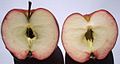 Cross section of the Red Autumn-Calville
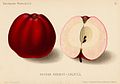 Red Autumn-Calville from "Deutsche Pomologie" (German Pomology) 1882


References
[edit source]- ↑ "Roter Herbstkalvill". Obstsorten Datenbank. BUND-Lemgo.
- ↑ Saint-Étienne, Claude (1670). Nouvelle instruction pour connaître les bons fruits. p. 208.
- ↑ Oberdieck, G.C; Lucas, E.; Jahn, F. (1855). Illustrirtes Handbuch der Obstkunde (PDF). pp. 51–52.
- ↑ Downing, Andrew Jackson (1845). The Fruits and Trees of America (PDF). p. 350.
- ↑ Stoll, Dr. Rudolf (1883–1884). Österreichisch-Ungarische Pomologie. pp. 111–113.
- ↑ Engelbert, TH (1889). Deutschlands Apfelsorten (PDF). p. 49.
External links
[edit source]- Roter Herbstkalvill in Deutschlands Obstsorten
- Arche Noah-Sortenblatt Roter Herbstkalvill (PDF-Datei; 316 kB)