


Donaldson's theorem
In mathematics, and especially differential topology and gauge theory, Donaldson's theorem states that a definite intersection form of a closed, oriented, smooth manifold of dimension 4 is diagonalizable. If the intersection form is positive (negative) definite, it can be diagonalized to the identity matrix (negative identity matrix) over the integers. The original version[1] of the theorem required the manifold to be simply connected, but it was later improved to apply to 4-manifolds with any fundamental group.[2]
History
[edit]The theorem was proved by Simon Donaldson. This was a contribution cited for his Fields Medal in 1986.[3]
Idea of proof
[edit]Donaldson's proof utilizes the Yang–Mills moduli space of solutions to the anti-self-duality equations on a principal -bundle over the four-manifold . By the Atiyah–Singer index theorem, the dimension of the moduli space is given by



where is a Chern class, is the first Betti number of , and is the dimension of the positive-definite subspace of with respect to the intersection form. When is simply-connected with definite intersection form, possibly after changing orientation, one always has and . Thus taking any principal -bundle with , one obtains a moduli space of dimension five.


This moduli space is non-compact and generically smooth, with singularities occurring only at the points corresponding to reducible connections, of which there are exactly many.[6] Results of Clifford Taubes and Karen Uhlenbeck show that whilst is non-compact, its structure at infinity can be readily described.[7][8][9] Namely, there is an open subset of , say , such that for sufficiently small choices of parameter , there is a diffeomorphism


- .

The work of Taubes and Uhlenbeck essentially concerns constructing sequences of ASD connections on the four-manifold with curvature becoming infinitely concentrated at any given single point . For each such point, in the limit one obtains a unique singular ASD connection, which becomes a well-defined smooth ASD connection at that point using Uhlenbeck's singularity theorem.[9][6]

Donaldson observed that the singular points in the interior of corresponding to reducible connections could also be described: they looked like cones over the complex projective plane . Furthermore, we can count the number of such singular points. Let be the -bundle over associated to by the standard representation of . Then, reducible connections modulo gauge are in a 1-1 correspondence with splittings where is a complex line bundle over .[6] Whenever we may compute:[10]


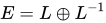

,

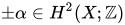
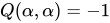
where is the intersection form on the second cohomology of . Since line bundles over are classified by their first Chern class , we get that reducible connections modulo gauge are in a 1-1 correspondence with pairs such that . Let the number of pairs be . An elementary argument that applies to any negative definite quadratic form over the integers tells us that , with equality if and only if is diagonalizable.[6]




It is thus possible to compactify the moduli space as follows: First, cut off each cone at a reducible singularity and glue in a copy of . Secondly, glue in a copy of itself at infinity. The resulting space is a cobordism between and a disjoint union of copies of (of unknown orientations). The signature of a four-manifold is a cobordism invariant. Thus, because is definite:

,

from which one concludes the intersection form of is diagonalizable.
Extensions
[edit]Michael Freedman had previously shown that any unimodular symmetric bilinear form is realized as the intersection form of some closed, oriented four-manifold. Combining this result with the Serre classification theorem and Donaldson's theorem, several interesting results can be seen:
1) Any definite non-diagonalizable intersection form gives rise to a four-dimensional topological manifold with no differentiable structure (so cannot be smoothed).
2) Two smooth simply-connected 4-manifolds are homeomorphic, if and only if, their intersection forms have the same rank, signature, and parity.
See also
[edit]Notes
[edit]- ↑ Donaldson, S. K. (1983-01-01). "An application of gauge theory to four-dimensional topology". Journal of Differential Geometry. 18 (2). doi:10.4310/jdg/1214437665. ISSN 0022-040X.
- ↑ Donaldson, S. K. (1987-01-01). "The orientation of Yang-Mills moduli spaces and 4-manifold topology". Journal of Differential Geometry. 26 (3). doi:10.4310/jdg/1214441485. ISSN 0022-040X. S2CID 120208733.
- ↑ "Fields Medals 1986 - Donaldson, Faltings, Freedman Achievements". www.mathunion.org. Retrieved 2026-07-04.
- ↑ Freed & Uhlenbeck 1984, p. 45-46
- ↑ Donaldson & Kronheimer 1990, p. 326
- 1 2 3 4 Donaldson, S. K. (1983). An application of gauge theory to four-dimensional topology. Journal of Differential Geometry, 18(2), 279-315.
- ↑ Taubes, C. H. (1982). Self-dual Yang–Mills connections on non-self-dual 4-manifolds. Journal of Differential Geometry, 17(1), 139-170.
- ↑ Uhlenbeck, K. K. (1982). Connections with L p bounds on curvature. Communications in Mathematical Physics, 83(1), 31-42.
- 1 2 Uhlenbeck, K. K. (1982). Removable singularities in Yang–Mills fields. Communications in Mathematical Physics, 83(1), 11-29.
- ↑ Donaldson & Kronheimer 1990, Eq. (4.2.13)
References
[edit]- Donaldson, S. K. (1983), "An application of gauge theory to four-dimensional topology", Journal of Differential Geometry, 18 (2): 279–315, doi:10.4310/jdg/1214437665, MR 0710056, Zbl 0507.57010
- Donaldson, Simon K.; Kronheimer, Peter B. (1990-09-13). The Geometry of Four-Manifolds. Oxford Mathematical Monographs. Oxford University Press. doi:10.1093/oso/9780198535539.001.0001. ISBN 978-0-198-53553-9. MR 1079726.
- Uhlenbeck, Karen K.; Freed, Daniel S. (1984). Instantons and Four-Manifolds. Mathematical Sciences Research Institute Publications. Vol. 1. Springer. doi:10.1007/978-1-4613-9703-8. ISBN 978-1-4613-9703-8.
- Freedman, M.; Quinn, F. (1990), Topology of 4-Manifolds, Princeton University Press
- Scorpan, A. (2005), The Wild World of 4-Manifolds, American Mathematical Society