


Divided power structure
 | This article may be too technical for most readers to understand. (October 2009) |
In mathematics, specifically commutative algebra, a divided power structure is a way of introducing items with similar properties as expressions of the form have, also when it is not possible to actually divide by . Just like there are polynomial algebras on n generators, there the foundational object in this setting is the divided power algebra on n generators.


Definition of a free divided power algebra on n generators
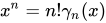
[edit]Let be a ring. The free divided power algebra on one generator over is and it is supposed to be defined as . Lets find a way of defining this without using division because division may not make sense in the ring . Define . Then


![{\displaystyle R{\bigl [}{\tfrac {x^{i}}{i!}}{\bigr ]}_{i}}](https://wikimedia.org/api/rest_v1/media/math/render/svg/5dcb5cbdc50338193817b60673bfd3cfaaed4f9a)


This means we can properly define to be
![{\displaystyle R[\gamma _{i}]/\left(\gamma _{i}\gamma _{j}={\binom {i+j}{i}}\gamma _{i+j}\right).}](https://wikimedia.org/api/rest_v1/media/math/render/svg/d2d5f5237f8db4b1639dd8bef06d27f99e01e4c5)
Thus this will be our definition of the divided power algebra . We define to be and we call this the free divided power algebra on generators over .


Definition of a divided power structure
[edit]The preceding section has the following generalization. Let A be a commutative ring with an ideal I. A divided power structure (or PD-structure, after the French puissances divisées) on I is a collection of maps for n = 0, 1, 2, ... such that:

- and for , while for n > 0.
- for .
- for .
- for , where is an integer.
- for and , where is an integer.


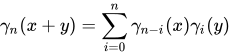




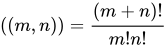


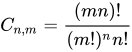
For convenience of notation, is often written as when it is clear what divided power structure is meant.

![{\displaystyle x^{[n]}}](https://wikimedia.org/api/rest_v1/media/math/render/svg/f11cdb7e5828f04d15acd4fe13cb86aedc16e68e)
The term divided power ideal refers to an ideal with a given divided power structure, and divided power ring refers to a ring with a given ideal with divided power structure.
Homomorphisms of divided power algebras are ring homomorphisms that respect the divided power structure on its source and target.
Examples
[edit]- The free divided power algebra over on one generator:

![{\displaystyle \mathbb {Z} \langle x\rangle :=\mathbb {Z} \left[x,{\tfrac {x^{2}}{2}},\ldots ,{\tfrac {x^{n}}{n!}},\ldots \right]\subset \mathbb {Q} [x].}](https://wikimedia.org/api/rest_v1/media/math/render/svg/570f0a1dbcff3f9e32021ab1a6d34f13ea24d300)
- One may see this as a divided power structure also by letting , the ideal generated by , and the map be defined by .
![{\displaystyle A=\mathbb {Z} [x]}](https://wikimedia.org/api/rest_v1/media/math/render/svg/f2079be6430067b7636aff38461cf1b8f9517a1d)


- If A is an algebra over , then every ideal I has a unique divided power structure where [1] Indeed, this is the example which motivates the definition in the first place.

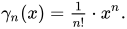
- If M is an A-module, let denote the symmetric algebra of M over A. Then its dual has a canonical structure of divided power ring. In fact, it is canonically isomorphic to a natural completion of (see below) if M has finite rank.


Constructions
[edit]If A is any ring then we have the free divided power algebra on n generators

defined in the first section above. Concretely it consists of so called divided power polynomials in the variables
- ,

that is sums of divided power monomials of the form
![{\displaystyle cx_{1}^{[i_{1}]}x_{2}^{[i_{2}]}\cdots x_{n}^{[i_{n}]}}](https://wikimedia.org/api/rest_v1/media/math/render/svg/0aa649a1ceab112a52f90b4fbdeec83274fc32d9)
with . The structure of a divided power algebra(of the third section) is given by letting I be the ideal of divided power polynomials with no constant coefficient.

More generally, if M is an A-module, there is a free divided A-algebra on M, called

with PD ideal

and an A-linear map
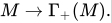
(The case of divided power polynomials is the special case in which M is a free module over A of finite rank.)
If I is any ideal of a ring A, there is a universal construction which extends A with divided powers of elements of I to get a divided power envelope of I in A.
Applications
[edit]The concrete divided power algebras of the first two sections are ubiquitous in algebraic topology since a free divided power algebra on n generators is just the dual of a polynomial algebra. The divided power envelope is a fundamental tool in the theory of PD differential operators and crystalline cohomology, where it is used to overcome technical difficulties which arise in positive characteristic.
The divided power functor is used in the construction of co-Schur functors.
See also
[edit]References
[edit]- ↑ The uniqueness follows from the easily verified fact that in general, .
- Berthelot, Pierre; Ogus, Arthur (1978). Notes on Crystalline Cohomology. Annals of Mathematics Studies. Princeton University Press. Zbl 0383.14010.
- Hazewinkel, Michiel (1978). Formal Groups and Applications. Pure and applied mathematics, a series of monographs and textbooks. Vol. 78. Elsevier. p. 507. ISBN 0123351502. Zbl 0454.14020.
- p-adic derived de Rham cohomology - contains excellent material on PD-polynomial rings and PD-envelopes
- What's the name for the analogue of divided power algebras for x^i/i - contains useful equivalence to divided power algebras as dual algebras