


Clearing denominators
 | This article has multiple issues. Please help improve it or discuss these issues on the talk page. (Learn how and when to remove these messages)
|


In mathematics, the method of clearing denominators, also called clearing fractions, is a technique for simplifying an equation equating two expressions that each are a sum of rational expressions – which includes simple fractions.
Example
[edit]Consider the equation
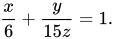
The smallest common multiple of the two denominators 6 and 15z is 30z, so one multiplies both sides by 30z:

The result is an equation with no fractions.
The simplified equation is not entirely equivalent to the original. For when we substitute y = 0 and z = 0 in the last equation, both sides simplify to 0, so we get 0 = 0, a mathematical truth. But the same substitution applied to the original equation results in x/6 + 0/0 = 1, which is mathematically meaningless.
Description
[edit]Without loss of generality, we may assume that the right-hand side of the equation is 0, since an equation E1 = E2 may equivalently be rewritten in the form E1 − E2 = 0.
So let the equation have the form

The first step is to determine a common denominator D of these fractions – preferably the least common denominator, which is the least common multiple of the Qi.
This means that each Qi is a factor of D, so D = RiQi for some expression Ri that is not a fraction. Then
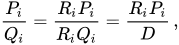
provided that RiQi does not assume the value 0 – in which case also D equals 0.
So we have now

Provided that D does not assume the value 0, the latter equation is equivalent with
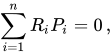
in which the denominators have vanished.
As shown by the provisos, care has to be taken not to introduce zeros of D – viewed as a function of the unknowns of the equation – as spurious solutions.
Example 2
[edit]Consider the equation

The least common denominator is x(x + 1)(x + 2).
Following the method as described above results in

Simplifying this further gives us the solution x = −3.
It is easily checked that none of the zeros of x(x + 1)(x + 2) – namely x = 0, x = −1, and x = −2 – is a solution of the final equation, so no spurious solutions were introduced.
References
[edit]- Richard N. Aufmann; Joanne Lockwood (2012). Algebra: Beginning and Intermediate (3 ed.). Cengage Learning. p. 88. ISBN 978-1-133-70939-8.