


// Workers AI · dad joke modeWhat did the centered nonagonal number say? It's odd to be centered.

A centered nonagonal number, (or centered enneagonal number), is a centered figurate number that represents a nonagon with a dot in the center and all other dots surrounding the center dot in successive nonagonal layers. The centered nonagonal number for n layers is given by the formula[1]
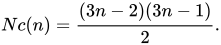

Multiplying the (n − 1)th triangular number by 9 and then adding 1 yields the nth centered nonagonal number, but centered nonagonal numbers have an even simpler relation to triangular numbers: every third triangular number (the 1st, 4th, 7th, etc.) is also a centered nonagonal number.[1]
Thus, the first few centered nonagonal numbers are[1]
The list above includes the perfect numbers 28 and 496. All even perfect numbers are triangular numbers whose index is an odd Mersenne prime.[2] Since every Mersenne prime greater than 3 is congruent to 1 modulo 3, it follows that every even perfect number greater than 6 is a centered nonagonal number.
In 1850, Sir Frederick Pollock conjectured that every natural number is the sum of at most eleven centered nonagonal numbers.[3] Pollock's conjecture was confirmed as true in 2023.[4]
Congruence Relations
[edit]- All centered nonagonal numbers are congruent to 1 mod 3.
- Therefore the sum of any 3 centered nonagonal numbers and the difference of any two centered nonagonal numbers are divisible by 3.
See also
[edit]References
[edit]- 1 2 3 Sloane, N. J. A. (ed.). "Sequence A060544 (Centered 9-gonal (also known as nonagonal or enneagonal) numbers)". The On-Line Encyclopedia of Integer Sequences. OEIS Foundation.
- ↑ Koshy, Thomas (2014), Pell and Pell–Lucas Numbers with Applications, Springer, p. 90, ISBN 9781461484899.
- ↑ Dickson, L. E. (2005), Diophantine Analysis, History of the Theory of Numbers, vol. 2, New York: Dover, pp. 22–23, ISBN 9780821819357.
- ↑ Kureš, Miroslav (2023-10-27). "A Proof of Pollock's Conjecture on Centered Nonagonal Numbers". The Mathematical Intelligencer. doi:10.1007/s00283-023-10307-0. ISSN 0343-6993.
Classes of natural numbers | |||||||||||||||||||||||||
|---|---|---|---|---|---|---|---|---|---|---|---|---|---|---|---|---|---|---|---|---|---|---|---|---|---|
| |||||||||||||||||||||||||
| |||||||||||||||||||||||||
| |||||||||||||||||||||||||
| |||||||||||||||||||||||||
| |||||||||||||||||||||||||
| |||||||||||||||||||||||||
| |||||||||||||||||||||||||
| |||||||||||||||||||||||||
| |||||||||||||||||||||||||
| |||||||||||||||||||||||||
