// Workers AI · dad joke modeWhat did anime-influenced animation say to its friend? "Toon" in later.
 | This article has multiple issues. Please help improve it or discuss these issues on the talk page. (Learn how and when to remove these messages)
|
| Part of a series on |
| Anime and manga |
|---|
 |
 Anime and manga portal Anime and manga portal |
Anime-influenced animation, also known colloquially as animesque, is a type of non-Japanese work of animation that is noticeably similar to or inspired by anime. Generally, the term anime refers to a style of animation originating from Japan. As Japanese anime became increasingly popular, Western animation studios began implementing some visual stylizations typical in anime—such as exaggerated facial expressions, "super deformed" versions of characters, and white radial lines appearing on screen when something shocking, frightening, or distressing occurs.

Although outside Japan, anime is specifically used to mean animation from Japan or as a Japanese-disseminated animation style often characterized by colorful graphics, vibrant characters and fantastical themes,[1][2][better source needed] there is debate over whether the culturally abstract approach to the word's meaning may open up the possibility of anime produced in countries other than Japan.[3][4][5] Additionally, anime-influenced series are occasionally defined as "anime" by some sources, in an attempt to classify all anime-styled works of non-Japanese origin.[6]
Americas
[edit]United States
[edit]Television
[edit]One of the first noted attempts from American companies on making a series visually inspired by anime was The King Kong Show in the late 1960s and early 1970s. A predominantly American animated series, it was the result of a collaboration between Toei Animation from Japan and Videocraft from America. The result was an animation with an anime-like visual style and a Japanese kaiju theme, that incorporated the art style of the Hanna-Barbera era in American TV animation.[7] Likewise, note that Hanna-Barbera's earlier series Frankenstein Jr. was heavily influenced by the Gigantor anime series, although its art style was more similar to that of other American series of the time. Another early example of this might be The Smokey Bear Show,[8][9][10] Johnny Cypher in Dimension Zero,[11] Challenge of the GoBots,[12][13][14][15] Hong Kong Phooey,[16] and Frosty the Snowman.[17][18][19][20][21][22][23]
Rankin/Bass Productions, in addition to collaborating with Toei Animation to make The King Kong Show, is also known for collaborating with Japanese anime studios to make several famous Christmas movies, such as Rudolph the Red-Nosed Reindeer (1964), Frosty the Snowman (1969), Santa Claus is Comin' to Town (1970), Here Comes Peter Cottontail (1971), 'Twas the Night Before Christmas (1974), The Year Without a Santa Claus (1974), The First Easter Rabbit (1976), Frosty's Winter Wonderland (1976), Rudolph's Shiny New Year (1976), The Easter Bunny is Comin' to Town (1977), Nestor, the Long-Eared Christmas Donkey (1977), The Stingiest Man in Town (1978), Jack Frost (1979), Rudolph and Frosty's Christmas in July (1979), Pinocchio's Christmas (1980), and Frosty Returns (1992).[24][25][26][27][28] Many of those Christmas movies were created by Arthur Rankin Jr. and Jules Bass, and features traditional animation, though not usually being styled as anime in the traditional sense, instead of the typical stop motion animation most often used by the company.
Toei Animation continued this type of collaboration in the Transformers TV series and its associated film, both of which aired in the 1980s. While Transformers was co-produced with Toei Animation, who handled several stages of the animation production process, the series was ultimately written in the United States. Transformers showed many influences and elements of anime including story, themes, and a style that resembled Mecha anime. This anime-style trend is applicable throughout the entire franchise as a whole, starting with other installments in the Generation 1 series, with numerous examples even being actual Japanese anime, such as Transformers: The Headmasters, Transformers: Super-God Masterforce, Transformers: Victory, and Transformers: Zone, as well as the unrelated reboot Transformers: Robots in Disguise, among others.[29][30][31]
This exact trend continued throughout the 1980s with series and movies like Dungeons & Dragons, X-Men: Pryde of the X-Men,[32][33][34][35] Spider-Man, Spider-Man and His Amazing Friends, Inhumanoids, Jem, Voltron,[36][37] Voltron: Fleet of Doom, GoBots: Battle of the Rock Lords,[38] Defenders of the Earth, The Adventures of the American Rabbit, The Glo Friends, Sky Commanders, Hello Kitty's Furry Tale Theater, The Real Ghostbusters, Superman, and Police Academy, all projects that were also co-produced by Toei Animation.
Throughout the 1980s and the 1990s, many American shows started to be outsourced to Japanese artists and animators, most notably TMS Entertainment and Sunrise, which animated popular television productions such as Inspector Gadget, The Real Ghostbusters, Mighty Orbots, Rainbow Brite, The Adventures of the Galaxy Rangers, Bionic Six, Tiny Toon Adventures, DuckTales, Chip 'n Dale: Rescue Rangers, Animaniacs, The Littles, The New Adventures of Zorro, Dennis the Menace, Spider-Man: The Animated Series, Batman: The Animated Series, and Superman: The Animated Series, most of which visually or thematically were not reminiscent of Japanese anime. TaleSpin (the animation was done at Walt Disney Animation Japan) did, however, take inspiration from Hayao Miyazaki's 1989 manga Hikōtei Jidai.[39]
Batman Beyond displayed some characteristics of anime; in particular, some of its production processes were outsourced to Japan.[40] Glen Murakami was also a strong influence in inspiring American series with Japanese elements. He animated alongside Bruce Timm on Batman: The Animated Series and its sequel, Batman: Beyond. Keeping the sharp-edged angular style of Timm and mixing in his own personal influences, the show was given cyberpunk and sci-fi elements with a Japanese twist. Adding onto the heavy anime influence, the direct-to-video film Batman Beyond: Return of the Joker combines both Batman Beyond and Batman: The Animated Series into the main plot; the film's animation was outsourced to TMS Entertainment in Japan.[41][42][43][44][45][46][47] American television producer Sam Register – who created anime inspired works such as Ben 10, its sequel Alien Force, Transformers Animated, Scooby-Doo! Mystery Incorporated, Beware the Batman, Mike Tyson Mysteries, Unikitty!, Hi Hi Puffy AmiYumi – also worked alongside Murakami to create the Teen Titans television show in 2003, giving rise to a unique style referred to as "murakanime". In 2004, Murakami also produced The Batman, which showed much stronger anime influence than even its predecessor Batman Beyond.[48]
At the same time, Godzilla: The Series is technically an adaptation of the American Godzilla movie, but has plentiful references to the Japanese films and has a more directly anime-looking aesthetic throughout the show. Godzilla himself is made to look more in line with his earlier Japanese design.[49][50][51]

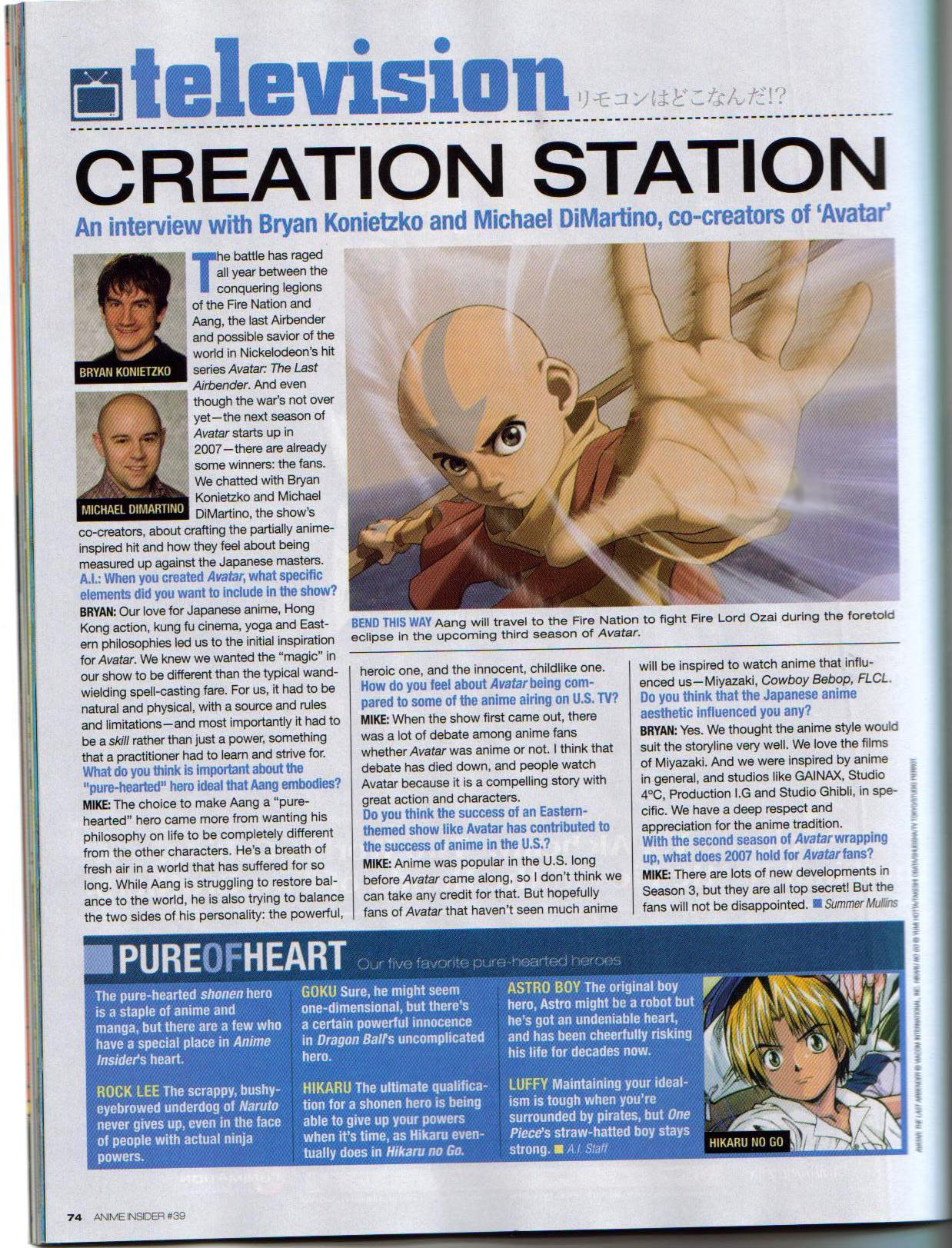
Avatar: The Last Airbender and its sequel series The Legend of Korra are other examples of American series influenced by anime so heavily that they started discussions among fans and viewers about what anime is and whether a non-Japanese animation should be called anime.[52] Avatar creators Bryan Konietzko and Michael Dante DiMartino confirmed an anime influence in a magazine interview; that of "Hayao Miyazaki, especially Spirited Away and Princess Mononoke"[53] as well as My Neighbor Totoro.[54] Other studios from which inspiration was drawn include Studio 4°C, Production I.G, Polygon Pictures and Studio Ghibli.[55]

The web series RWBY, produced by Texas-based company Rooster Teeth premiered in July 2013, is produced using an anime-heavily influenced art style and has been referred to as an American anime by multiple sources.[3][56] For example, when the series was licensed for release in Japan, AdWeek reported on the situation using the headline "American-made anime from Rooster Teeth gets licensed in Japan".[57] The CEO of Rooster Teeth, Matt Hullum, commented on the licensing agreement, saying "This is the first time any American-made anime has been marketed to Japan. It definitely usually works the other way around, and we're really pleased about that."[57] In 2013, Monty Oum, the creator of RWBY, said "Some believe just like Scotch needs to be made in Scotland, an American company can't make anime because it's impossible at all. I think that's a narrow way of seeing it. Anime is an art form, and to say only one country can make this art is wrong."[3] Furthermore, RWBY was often dubbed in Japanese version, and even got a 2016 spin-off series RWBY Chibi, which depicts the characters in the style and appearance of chibi and depicts them in situations akin to that of typical of Japanese chibi parodies. Eventually, in 2022, RWBY was given an actual Japanese animation called Ice Queendom, making it one of the very first anime-based series to have actually developed a true Japanese animation based on an American project.[58]
The Powerpuff Girls animated series, as well as its reboot and film adaptation were all heavily influenced by anime to begin with, with the three main characters being obvious examples. For this, the franchise was revered by not just American viewers, which was its intended target audience, but also Japanese viewers as well.[59] As a result of the cartoon's major popularity in Japan, the show was given an anime spin-off known as Z that debuted on July 1, 2006. The Z spinoff is loosely based on the original series, with plot details and characters very similar to their depiction from the series. The Powerpuff Girls stands as one of the very first anime-based series to have actually developed a true Japanese animation based on an American project.[60][61][62]
G.I. Joe, despite it being primarily and notably an American series, film, and toy line franchise, is notable for having quite a handful of anime influences in their animations. The first and most notable example, G.I. Joe: A Real American Hero, both the first and second seasons, as well as the film adaptation, were all outsourced in Japan by the studio Toei Animation, who was also known for making The Transformers. The second, G.I. Joe: Sigma 6, was actually the closest known G.I. Joe property to ever be translated into Japanese animation in any form despite it still being an American series; it was animated by the Japanese studio Gonzo, and it was produced by 4Kids Productions in America. Third, G.I. Joe: Resolute was a web series produced by Titmouse, Inc., and the animation was noted to be extremely similar to that of Avatar: The Last Airbender and the works of Madhouse Studios, especially its character designs and fight scenes. Finally, the most recent one to date so far, G.I. Joe: Renegades, despite it being primarily an American series, had plenty of anime references, particularly its frequent usage of Ninja culture and stylized fight choreography.[63][64][65]
ThunderCats, both its 1985 and 2011 series, are outsourced and produced by Japanese animators, like that of Studio 4°C, and thus both series have several references and visuals reminiscent to anime all throughout. The most recent one, Roar, made in 2020, even has a chibi-style animation similar to the style used in Teen Titans Go!.[66][59][67]
The American animated sitcom The Boondocks has many anime-style features and uses Japanese style fighting. It is shown in many scenes, as Japanese sword styles have been used. Additionally, the aesthetics are notably very similar to Japanese animation, due to the series being partially outsourced to Japanese and Korean artists, most notably Madhouse Studios. However, despite this, Madhouse was never credited with its involvement with the cartoon.[68]
The Mexican-American Onyx Equinox, created by Sofia Alexander, and the American High Guardian Spice, created by Raye Rodriguez, are both Western series that were released on Crunchyroll, a streaming platform that typically features Japanese anime shows and manga. Both series are notably extremely similar to Japanese anime, taking visual cues from Avatar: The Last Airbender, its sequel The Legend of Korra, and She-Ra and the Princesses of Power, and were also produced by South Korean animation company DR Movie.[69][70]
The entirety of the My Little Pony franchise is notable for implanting anime visuals and tropes, especially in the animation, with the entire franchise being an example of a Westernized version of the magical girls genre used in Japanese works. My Little Pony: Friendship Is Magic, as well as its associated film, in particular, is extremely similar in appearance and aesthetic to what would be used in Japanese anime, especially the character designs and plots used in their episodes.[71][72][73]
.jpeg)

Steven Universe, as well as its television film adaptation and Future, are notable for possessing anime aesthetics resembling that from Dragon Ball Z and especially the works of Osamu Tezuka and Harvey Kurtzman.[59][74] Most notably, the protagonist team, the Crystal Gems, are directly inspired and modeled after magical girls, and there are plenty of references to anime throughout the original and sequel shows. As for anime influences, series creator Rebecca Sugar has cited Whisper of the Heart as her "absolute favorite" film and as a major influence on her work, even providing an introduction for screenings in July 2019.[75][76] She also cited the anime series Revolutionary Girl Utena as an "epiphany" for her, by playing with "the semiotics of gender" and called it beautiful, funny, and extreme, having a huge influence on her, and noted the "huge Takarazuka Theater influence" in Steven Universe.[77][78]
ND Stevenson and the crew of She-Ra and the Princesses of Power were strongly influenced by anime, especially those with magical girls.[59]
DC Super Hero Girls was already heavily inspired by anime despite the web series and franchise consisting of direct-to-video and television films all primarily having an American art style and animation format. However, the 2019 reboot is even further inspired by anime through the art style and fluid animation alone, which was because of the creator Lauren Faust using a similar art style to her previous work, My Little Pony: Friendship is Magic.[59][79][80]
My Adventures with Superman was primarily an American production, but was thematically and visually inspired by Japanese anime, with its animation and aesthetics heavily reminiscent to that of a shonen anime.[81]
Hazbin Hotel and its web spinoff Helluva Boss have been frequently interpreted by viewers and fans as an anime despite being an American series. According to series creator Vivienne Medrano, both animated series got their primary influence from other American series, such as Disney's movies and Broadway musicals.[82] That said, both also possess plentiful anime references, particularly in terms of animation, visual effects, character design, and iconography, making Hazbin Hotel and Helluva Boss recent examples of American series being comparable to anime.[59][83][84]
Film
[edit]Even though it was derived from an American comic strip, Little Nemo: Adventures in Slumberland was animated by the Japanese company Tokyo Movie Shinsha and thus is often considered an anime film, although it was a joint production of Japanese and American animators and production companies. Despite being infamously trapped in development hell for much of the 1980s, many notable people were involved with the film's production at some point before dropping out, with the workers coming from Disney, Lucasfilm, Warner Bros. Animation, and Studio Ghibli.[85][86][87][88][89][90][91][92]
The production on The Animatrix began when the Wachowskis visited some of the creators of the anime films that had been strong influences on their work, and decided to collaborate with them.[93][94] Warner Bros. Home Video, Universal Home Video, and Japanese animation studio Gonzo, among others even personally tried to replicate the same animation process that was used from The Animatrix, which led to the creation of Batman: Gotham Knight, Halo Legends, Gankutsuou: The Count of Monte Cristo and The Chronicles of Riddick: Dark Fury. The two projects were notably produced through collaborations with Mahiro Maeda, Yoshiaki Kawajiri, and Peter Chung, all three of whom had worked in The Animatrix.[95][96][97][98][99][100][101][102][103][104][105][106]
Starship Troopers, including the novel made by Robert A. Heinlein and then the movie franchise created by Edward Neumeier and Paul Verhoeven, had already spawned several animated projects, including Roughnecks: Starship Troopers Chronicles,[107][108][109] itself heavily reminiscent of anime. Additionally, Starship Troopers was also unexpectedly popular in Japan, leading to the development of three separate animations from that country. The 1988 anime miniseries of the same name is the closest known adaptation of the novel and was produced by Japanese animation studio Sunrise. 24 years later, two Japanese-American direct-to-video CGI animated films, Invasion (2012) and Traitor of Mars (2017), were both designated to continue the storyline from the movie trilogy but through a different format than that of the typical live-action movies with CGI and stop motion. Both sequel films were created by Shinji Aramaki and Joseph Chou.[110][111][112][113][114][115]
Blade Runner, based on the 1968 novel Do Androids Dream of Electric Sheep? by Philip K. Dick, has two Japanese animated adaptations that are based on the movies: Black Out 2022, an anime short film made in 2017 by Shinichirō Watanabe, who is famous for directing other anime projects like Cowboy Bebop, Samurai Champloo, Carole & Tuesday, and Space Dandy;[116][117][118] and Black Lotus, a CGI series made in 2021 by Kenji Kamiyama and Shinji Aramaki, both of whom have developed projects such as Starship Troopers: Invasion, Starship Troopers: Traitor of Mars, Appleseed, Appleseed Ex Machina, Viper's Creed, Halo Legends, Jin-Roh, Ghost in the Shell: Stand Alone Complex, Eien no 831, and Guardian of the Sacred Spirit.[119][120][121]
The Lord of the Rings and The Hobbit, both created by English author J. R. R. Tolkien, have both been adapted into animated projects as early as in 1967; five of those animations have been completed through the efforts of Rankin-Bass and American animators Ralph Bakshi and Gene Deitch,[122] and all of them were actually partially outsourced by British and Japanese artists and animators. The first was The Hobbit, a short film meant to be part of a larger scale animated project, but had never materialized. The first official animated adaptation was The Hobbit in 1977, made by Rankin Bass. The second was The Lord of the Rings in 1978, made by Bakshi as the first part of what was originally intended to be a two-part adaptation of the story.[123] The third, The Return of the King was a 1980 television special again made by Rankin-Bass.[124] All three animated films were heavily anime-based, despite being made in the United States for an American audience. Recently, in 2024, the closest, if not the first time, the franchise had ever been translated into Japanese animation was The War of the Rohirrim, which was a New Zealand-American-Japanese co-production.[125][126][127]
Japanese anime has majorly influenced Disney, Pixar and DreamWorks productions. Glen Keane, the animator for successful Disney films such as The Black Cauldron (1985), The Little Mermaid (1989), Beauty and the Beast (1991), Aladdin (1992), and Tangled, has credited Hayao Miyazaki as a "huge influence" on Disney's animated films ever since The Rescuers Down Under (1990).[128] Gary Trousdale and Kirk Wise, the directors of Disney films such as Beauty and the Beast, Hunchback of Notre Dame (1996), and Atlantis: The Lost Empire (2001), are fans of anime and have cited Miyazaki's works as a major influence on their own work.[129] Miyazaki's influence on Disney dates back to The Great Mouse Detective (1986), which was influenced by Miyazaki's Lupin III film Castle of Cagliostro (1979) and which in turn paved the way for the Disney Renaissance.[130][131] It was especially inspired by the adventures of the 1994 Disney movie The Lion King Doraemon. In particular, Roger Allers had stated in an interview that he went to Japan before 1988, the year the production of The Lion King started, and that he was very impressed by the adventures in Doraemon, and that The Lion King was greatly influenced by Doraemon. Fujiko Fujio, despite the controversy, later thanked Disney in 1995 for being impressed by Disney's The Lion King and praising Doraemon.[132]
Controversy surrounded another Disney film, Atlantis: The Lost Empire, which was alleged to have plagiarized the Studio Gainax anime series Nadia: The Secret of Blue Water (1990).[129][133] Atlantis directors Gary Trousdale and Kirk Wise denied the allegation, but nevertheless acknowledged Miyazaki's films as a major influence on their work.[129]
Miyazaki's work deeply influenced Pixar co-founder John Lasseter, who described how Miyazaki's influence upon his life and work began when he first saw Castle of Cagliostro.[134] Pete Docter, director of the popular Pixar films Monsters, Inc. (2001) and Up (2009) as well as a co-creator of other Pixar works, has also described anime, specifically Miyazaki, as an influence on his work.[135] Jennifer Lee and Chris Buck cited the influence of Miyazaki's anime productions on Frozen (2013), stating that they were inspired by their sense of "epic adventure and that big scope and scale and then the intimacy of funny quirky characters."[136] Chris Sanders and Dean DeBlois described Miyazaki's flight and pacifist themes as an influence for creating How to Train Your Dragon (2010). Joel Crawford, the director of Puss in Boots: The Last Wish (2022), cited Akira (1988) as an influence on the design of the characters and action within the film. Additionally, the film utilized 2D animation to "highlight the personal touch of hand-drawn animation that is found in traditional anime", as noted by Variety's Jazz Tangsay.[137]
Catwoman: Hunted is predominantly an American animated production, but is also one of the more recent examples of an animation being heavily influenced and being so visually and stylistically close to Japanese anime that it is yet another source of debate as to the actual definition of anime. Adding on to the confusion is the fact that it was heavily commercialized as an anime, or at least an anime styled, film when it was announced in 2021 and again when it was released the following year. The anime style is even more accentuated by OLM, a Japanese studio behind the Pokémon anime series; the studio provided their animation services for the film alongside their Team Inoue.[138][139]
Video games
[edit]Pac-Man, a Japanese video game franchise, has an American series that was produced by Hanna-Barbera. Made in 1982, the series was very faithful to the source material in terms of plotline, characters and their names, and references to the original games.[140] It also stands out as the very first cartoon based on a video game, as well as the first cartoon to be based from a Japanese franchise.[141][142][143][144][145][146]
Captain N: The Game Master is a crossover animated series that focuses upon several video games that were originally created in Japan, including Kid Icarus, Mega Man, Castlevania, Donkey Kong, Metroid, The Adventures of Bayou Billy, Dragon Quest, The Legend of Zelda, and Wizards & Warriors, among others; the animation itself has been heavily styled by anime despite the series itself being predominantly an American media project.[147][148][149][150]
While the Sonic the Hedgehog franchise is originally a Japanese IP, it also has popular influence in Italy, France, Canada, and the United States, which led to animated co-productions in the form of Adventures of Sonic the Hedgehog (1993–1996),[151][152] the TV series of the same name (1993–1994),[153][154] Underground (1999),[155][156] Boom (2014–2017)[157] and Prime (2022–2024).[158][159] Meanwhile, in Sonic's home country, Japan, two animated projects exist in form of the anime movie of the same name (1996),[160][161] and X (2003–2005).[162][163][164][165][166]
While Street Fighter is a Japanese property to begin with, one particular animated television series based on the franchise, Street Fighter (1995), was primarily made in the United States and Canada. The series was produced by Japanese artists, most notably Madhouse Studios and Sunrise, Inc., allowing itself for plentiful anime references and visuals, while also making references to the first movie and the earlier games.[167][168]
Sin: The Movie is a 2000 original video animation released by ADV Films, adapted from the American video game of the same title. It is an example of a Japanese-American project that was directly based on a Western video game.[169][170][171][172]
Devil May Cry is originally a Japanese franchise, with its very first animated adaptation being that of an actual anime miniseries produced by Madhouse Studios in 2007.[173][174][175][176][177][178][179][180] However, eighteen years later, due to the franchise's popularity in America, Adi Shankar, one of the producers of the similarly anime-styled Castlevania, developed an American-South Korean anime-based series based on Devil May Cry, which was animated by Studio Mir in South Korea, the same studio that animated other notable anime-inspired shows like The Legend of Korra, Voltron: Legendary Defender, Kipo and the Age of Wonderbeasts, Dota: Dragon's Blood, Skull Island, and the fourth and final season of The Boondocks. The series was released on Netflix.[181][182][183][184][185][186][187][188]
The EA videogames Dead Space and Dead Space 2 has developed two American animated films, Downfall (2008) and Aftermath (2011), both of which were released direct-to-video. Both films were aesthetically influenced by anime and were distributed by Manga Entertainment, which typically produces and distributes Japanese animation.[189][190][191][192][193][194]
The American videogame Dante's Inferno, loosely based on Dante Alighieri's Divine Comedy, particularly Inferno, was adapted into a 2010 anime-based movie that was developed by the combined efforts of American, Japanese, Singaporean, and South Korean artists. Several known Korean and Japanese animation studios have done their part to contribute to this film, such as Production I.G, Dong Woo Animation, Manglobe, and Digital eMation.[195][196]
The popular BioWare and EA videogame franchises Mass Effect and Dragon Age have both developed their own Japanese-American animated projects in 2012, Mass Effect: Paragon Lost and Dragon Age: Dawn of the Seeker. Both anime films were made to promote the release or to give clarity to the plot holes of certain videogames as official prequels, particularly for that of Dragon Age: Origins and Mass Effect 3, respectively.[197][198][199][200] Dragon Age in particular would appear in animated form again in 2022 as Dragon Age: Absolution, where unlike Dawn of the Seeker, the series is not an actual anime, nor was it made in Japan. However, it was produced by Red Dog Culture House, a South Korean animation studio, and the series does thematically resemble anime in many ways, particularly through the animation, character design, and fight scenes. Chronologically, Absolution is established to take place after the conclusion of Dragon Age: Inquisition, as characters make reference to events in that game, but before the events of the upcoming video game Dragon Age: Dreadwolf.[201][202][203]
Brazil
[edit]The first time an anime-inspired animation appeared was in the 1960s when the airline Varig aired TV commercials to promote flights between Rio de Janeiro and Tokyo, adapting the story of Urashima Tarō with a cartoonish visual style reminiscent of early Japanese animation.[204]
Since the 2000s there have already been countless independent projects for animated series inspired by anime. One of the first attempts was an animated adaptation of the popular manga-styled comic Holy Avenger after its completion in 2003,[205][206] however due to financial and production problems the series was never developed. Over the years several other attempts for independent projects for animation inspired by Brazil were created, the most notable being Dogmons!,[207] XDragoon[208] and Magma.[209][210]
In 2021 an independent platform for anime-inspired animations titled Anistage was created.[211] In 2025 an animated adaptation of the webcomic Rei de Lata was announced for 2027 produced by the independent animation studio Kimera Estúdio.[212]
Among the anime-inspired Brazilian animated series that premiered on TV are Os Under-Undergrounds that debuted in May 2016, Nickelodeon[213] and Turma da Mônica Jovem, based on the manga-styled comic created by Mauricio de Sousa, that debuted on November 7, 2019.[214]
Chile
[edit]Animated series such as Golpea Duro Hara, a show which was an inspiration of the Japanese series such as Dragon Ball and One-Punch Man, was released in 2018. The second season was released in 2020 on Cartoon Network.
In 2020, the Chilean-Brazilian animated film, Nahuel and the Magic Book, was created and inspired by the works of Hayao Miyazaki's projects such as Future Boy Conan and the entire Studio Ghibli with the mixtures of other American animated series such as Steven Universe and Gravity Falls based on its characters. It became the first Latin American feature to win the Tokyo Anime Award for Award of Excellence a year later.[215]
Other countries in the Americas
[edit]In 2007, the Canadian anime-style animated short Flutter became the first work from a non-Asian nation to win the Open Entries Grand Prize at the Tokyo Anime Awards.[216]
The Australian independent web series The Amazing Digital Circus and Murder Drones, both produced by Glitch Productions, are entirely Western-styled CGI cartoons in terms of animation, art, and visual design, but there are also plentiful anime elements that can be seen within both series, particularly from the character designs, facial expressions, reaction shots, fluidity of animation, and action sequences.[217][218][219][220][221][222][223][224][225][226][227][228][229][230][231]
Europe
[edit]France
[edit]Highlander: The Animated Series is a 1994 animated series based on the British-American Highlander franchise. Despite being confused as an anime due to the series's visual style, it is actually a French animated series.[232] It is a loose spin-off and sequel of the 1986 film of the same name and depicts some of the characters from that film. The series was notably the first animated production of Gaumont Télévision (later Gaumont Multimédia), and later Xilam,[233] with the worldwide distribution rights owned by Bohbot Entertainment (later BKN International).[234][235]
.png)
The French-American international co-production W.I.T.C.H., a magical girl series,[236][237] has been noted as having an anime-influenced visual style.[238][239] First season director Marc Gordon-Bates cited anime such as Neon Genesis Evangelion as design inspiration.[240] The animated series is based on Italian comics of the same name themselves drawn in line with manga conventions, as opposed to the more rounded style traditionally used by publisher and co-producer Disney.[241] Co-executive producer Olivier Dumont noted that the high-quality animation was intended to be true to the detailed artwork of the comics series.[242]
The producers of the French anime Code Lyoko, one of the most successful works of European anime, explicitly stated in their introductory document that they were: "Influenced by the poetry and the visual impact of Japanese animation, the series proposes a graphic universe that's particularly original and strong."[243]
The French-Canadian-American Fantastic Four: World's Greatest Heroes series was heavily stylized to look very similar to Japanese anime; however, the series was never produced in Japan. Instead, it was co-produced by American company Marvel Entertainment and French company MoonScoop Group, with the participation of M6 and Cartoon Network Europe and is distributed by Taffy Entertainment.[244][245]
The animation and style in Miraculous: Tales of Ladybug & Cat Noir is practically influenced by various Magical girl anime. Toei Animation does some of the modeling for the series, and was originally going to be in an anime-esque art-style. Thomas Astruc, the creator of the show, stated that the production team switched to CGI instead because Ladybug's spots were hard to animate around that time.
The French-German animated series SantApprentice, created by Jan Van Rijsselberge, has an animation and art style very similar to that of Japanese anime. It's two films Santa's Apprentice and The Magic Snowflake, both examples of collaborative work from France, Belgium, Ireland, and Australia, further that similarity by implementing anime tropes into the animation work.[246][247][248][249]
Another example of example of a French animation that is repeatedly defined as "anime" can be seen in Wakfu: The Animated Series, a flash animation series based on a video game of the same title, and Captain Laserhawk: A Blood Dragon Remix, a Netflix series inspired by the 2013 video game Far Cry 3: Blood Dragon and amalgamates elements and characters from several other Ubisoft franchises, despite both series having been made in France and America.[250][251][252][253][254]
Blue Eye Samurai is frequently mistaken to be an actual Japanese anime due to its setting being in the Edo period of Japan, as well as its animation being heavily influenced and stylized to appear as a typical anime would, such as Japanese depictions and references and the action sequences. However, it is actually a French-American co-production, and was animated by the studio Blue Spirit, a French company.[255][256][257] The creators expressly wanted the series to "look like a moving painting" with character design drawn from bunraku puppets. Inspiration was taken from the character Zatoichi, the "Man with No Name", and the works of Akira Kurosawa.[258][259][260]
Spain
[edit]In 2018, Movistar+ released Virtual Hero, a Spanish animated series created by YouTube personality El Rubius. It was dubbed as the "first anime in Spanish history".[261] The Netflix original "The Idhun Chronicles", based on The Idhún's Memories book saga written by Laura Gallego, premiered in September 10, 2020, also featuring an anime-style animation.[262]
Other European countries
[edit]
Some French, Italian and Canadian co-produced series have also been influenced by anime, such as Totally Spies!,[263] Martin Mystery, and Team Galaxy.
The visual style of the Italian animated series Winx Club is a mixture of European and Japanese elements, and also very similar to magical girl subgenre.[264]
Asia
[edit]East Asia
[edit]The animated movies The Adventures of Jinbao and Ratchet and Clank, despite them ostensibly being American-based, were both made in Hong Kong and China. While The Adventures of Jinbao is heavily influenced by anime to the point where several anime websites outright list it as such, it was actually made in China, and therefore is an example of a donghua.[265] Meanwhile, Ratchet and Clank also indeed has both anime aesthetics and references all throughout the film, but the animation itself is made to be more in line with the games rather than actual Japanese animation.[266][267]
China
[edit]Donghua stands for Chinese animation. Most Chinese animated series are produced in 3D such as Douluo Dalu (Soul Land), others like The Kings Avatar have gained global recognition in an emerging industry as more and more Manhuas are being adapted.
South Korea
[edit]Olympus Guardian and its associated film Olympus Guardians: Gigantes Counterattack is a South Korean anime-influenced animated television series based on "The Greek and Roman Myths in Comics" books published by Gana Publishing Co., a publishing company specializing in comics. From 11 December 2002 to 30 July 2003, it was developed into an animated film by SBS, SBS Productions, SBSi, Gana Entertainment and Dongwoo Animation and aired on SBS.[268][269]
YooHoo & Friends is an anime inspired 2009 series produced by Aurora World, but it is primarily animated by nSac Entertainment, which is based in South Korea.
Ark is an American-South Korean anime-based movie that predominantly features many archetypes taken from Final Fantasy-style Japanese console RPGs; it is the spiritual successor to Elysium (2003) which takes place in the same universe as the film.[270]
MetaJets is a South Korean-Canadian animated television series produced by Cookie Jar Entertainment and Sunwoo Entertainment. It was displayed in stations like Teletoon, KBS1, TF1, and Cartoon Network.[271][272]
Rainbow Ruby is a South Korean-Chinese-Canadian children's CGI animated television series distributed by WildBrain. The series was animated and produced by 38 °C Animation Studio and CJ E&M Corporation in South Korea and China Entertainment Corporation (a subsidiary of China ACG Group,[273] which is an enterprise directly under the PRC Government's Ministry of Culture[274][275]) in Korea.[276][277][278][279] CPLG, a brand licensing agency which became a subsidiary of DHX Media in 2012, represents Rainbow Ruby worldwide except Asia and Latin America.[280][281][282][283][284][279] The animation is meant to reference the magical girls genre, common in Japanese animated works.
Red Shoes and the Seven Dwarfs, known in Korean as simply Red Shoes, is an English-language South Korean animated fantasy film produced by Locus Corporation and is distributed by Next Entertainment World.[285] The film is based on the 1812 German-language fairy tale "Snow White" by the Brothers Grimm and its name is derived from the 1845 Danish fairy tale The Red Shoes by Hans Christian Andersen.[286][287][288]
Kipo and the Age of Wonderbeasts is an American-South Korean anime-styled Netflix series based from Radford Sechrist's 2015 webcomic Kipo. The animated series is produced by American company DreamWorks Animation Television in partnership with South Korean animation studio Mir.[289] In terms of inspiration for the plot, Sechrist compared the series to The Wizard of Oz, "but instead of ruby slippers [Kipo] has Converse on". The series is notable for referencing the Dragon Ball franchise multiple times, with some characters even having their own "super saiyan" forms.[290][291]
Middle East
[edit]The Emirati-Filipino produced TV series called Torkaizer is dubbed as the "Middle East's First Anime Show", inspired from Japanese mecha media franchise Gundam, and is currently in production,[5] which is currently looking for funding.[292]
Southeast Asia
[edit]The 2015 Indonesian animated movie, November 10th is also a kind of anime-influenced animated movie. There's also some other examples of Indonesian anime-influenced animated movie can be found on YouTube and some streaming websites.
In June 2021, the Singaporean anime-influenced TV series, Trese was released on Netflix. It is an adaptation of the Filipino komik series of the same name produced by Southeast Asian BASE Entertainment.[293][294]
South Asia
[edit]Pakistan
[edit]A Pakistani hand-drawn romantic anime film called The Glassworker was produced. It is directed by Usman Riaz. The trailer of the film was released in October 2016. The film was released in 2024 as described by the animation studio's website. It is also Pakistan's and South Asia's first crowd funded movie as it had raised $116,000 on Kickstarter. The reason for this high raise was due to Usman Riaz being a famous musician, speaker, and cinematographer. The movie is hand drawn so the scenes of the movie gives it a Studio Ghibli vibe through its art style.[295]
India
[edit]In India, Karmachakra was produced as one of the first Indian anime influenced animations under Studio Durga.[296]
Controversy and debate regarding the true definition of anime
[edit]The advent of Japanese anime stylizations appearing in Western animation questioned the established meaning of "anime".[6] Defining anime as style has been contentious amongst critics and fans, with John Oppliger stating, "The insistence on referring to original American art as "anime" or "manga" robs the work of its cultural identity."[2][297]
On the other hand, series like Avatar: The Last Airbender, its sequel, Castlevania, its sequel, RWBY, and Voltron: Legendary Defender have opened up more debates on whether these works should be called "anime", and whether the culturally abstract approach to the word's meaning may open up the possibility of anime produced in countries other than Japan.[3][4][5] While some Westerners strictly view anime as a Japanese animation product,[2] some scholars suggest defining anime as specifically or quintessentially Japanese may be related to a new form of orientalism[298] with some fans and critics arguing that the term should be defined as a "style" rather than as a national product, which leaves open the possibility of anime being produced in other countries.[1][4]
Foreign animation such as Oban Star-Racers and Code Lyoko, and even internationally produced anthologies such as Batman: Gotham Knight and Star Wars Visions, just like with Avatar: The Last Airbender and RWBY, are examples over which some critics and fans debate about the term anime and whether it is defined as a "style" rather than as a national product, which leaves open the possibility of anime being produced in other countries.[1][4][299][300][301]
One of the key points that differentiated anime from a handful of Western series is the potential for visceral content. Once the expectation that the aspects of visual intrigue or animation are just for children is put aside, the audience can realize that themes involving violence, suffering, sexuality, pain, and death can all be storytelling elements utilized in anime just as much as other media projects.[302]
In advertising
[edit]7-Eleven developed an anime-styled commercial through the collaboration with The Answer Studio, in relation to its ubiquity in Japan.[303][304]
The American fast-food Taco Bell advertisement Fry Force has many anime-style features, particularly from Japanese mecha anime Gundam. It is shown in many scenes, as Gundam fighting styles have been used.[305] At the same time, McDonald's had also created its own anime-styled advertisement, WcDonald's, created through the collaborations of Studio Pierrot.[306]
The Odyssey Interactive Omega Strikers action sport video game has a heavy anime influence on its launching advertisement video because it was made by the Japanese animation studio Trigger. The commercial was made specifically in celebration of the premiere launch of its video game.[307]
The Bulgarian juice company Florina had anime-style mascots of the juice flavours named Flo Force,[308] advertised in many youth activities.[309]
Pepsi was featured in commercials and advertisements in the Tiger and Bunny universe, with one particular character, Blue Rose, being frequently depicted as referencing or sponsoring the company in various ways. The commercials started off as a meta depiction within the anime series, but the popularity of Blue Rose resulted in these commercials becoming used as actual advertisements in reality for the titular soda company.[310]
As part of an advertising campaign for the fourth and final season for the Attack on Titan anime series, an animated commercial was made to sell Snickers bars that were specifically designed to promote the series for a limited time. The commercial depicts the main characters fighting against the titular Titans using giant Snickers bars.[311][312]
Dragon Ball Z has been referenced in multiple advertisements, including one sponsored by Ford Motor Company, with the particular advertisement named Dragon Car Z, and another sponsored by KFC.[313][314]
Fanta sponsored a commercial depicted in the One Piece universe where the characters Monkey D. Luffy and Tony Tony Chopper start rapping about the soda drink. This led to eight specific designs being made on the soda bottles that were then marketed and sold in stores for a limited time.[315]
Windows 7 developed its own advertisement, "Nanami Madobe's Windows 7 Build-It-Yourself PC Commercial!!", which primarily features Japan's titular Windows 7 mascot character, voiced by Nana Mizuki. The commercial's popularity led to it being sold on DVD.[316]
In response to the widespread popularity of Kit Kats throughout Japan, an anime-styled commercial was made based on the candy bars to increase its marketing value.[317]
In music
[edit]The music video for the Linkin Park song "Breaking the Habit" was animated by Gonzo;[318] it was also directed by Joe Hahn and co-produced by Eric Calderon, and uses an anime stylization which was supervised by Kazuto Nakazawa, who had previously directed the animated segment of Quentin Tarantino's Kill Bill: Volume 1 among other things.[319][320] The video was shot of the band performing the song and was later rotoscoped.[321] A similar situation happened with a music video for the band Dream Theater, for their song "Forsaken." Also animated by Gonzo, the animated music video was directed by Yasufumi Soejima, and was also rotoscoped in a similar style as with "Breaking the Habit."[322]
Pharrell Williams released a music video for the 2014 song "It Girl"; the animation was directed by Mr. and Fantasista Utamaro and was released on September 30, 2014.[323] Produced by Japanese designer Takashi Murakami in his company Kaikai Kiki[324] with Animation Production NAZ,[325] the anime-inspired clip features Williams rendered in the style of various Japanese series and video games.[326]
The Weeknd released an animated music video for his 2020 song "Snowchild";[327] it was directed by D'Art Shtajio studio and is set after the events of the "Until I Bleed Out" music video.[328] It was described by journalists as "A Dark Trip Down Memory Lane", as it showcases Tesfaye's different looks and the general atmosphere of his music throughout the six main stages of his career.[329] The whole music video was deliberately done in the Japanese animation style of anime.[330]
Matthew Sweet released a live-action/animated music video based on his "Girlfriend" album. It featured clips from the anime film Space Adventure Cobra: The Movie, mainly featuring the character Jane Royal. The video for another one of the album's singles, "I've Been Waiting", used clips of the Urusei Yatsura character Lum.[331]
Interstella 5555, a French-Japanese anime film, is a unique case in which it is technically a whole feature-length film as opposed to a single music video, but it features songs throughout the entire film instead of dialogue, and features the Daft Punk songs "One More Time", "Digital Love" and "Harder, Better, Faster, Stronger".[332]
"Shelter" is a result of the collaboration between by American DJ and record producer Porter Robinson, French DJ and record producer Madeon, and Japanese studio A-1 Pictures. The video was released on October 18, 2016, on Robinson's YouTube channel in partnership with Crunchyroll.[333] Robinson originally approached A-1 Pictures to make the video because it was the studio that created Anohana,[334] an anime series that matches his creative style. Based on an original story written by Robinson, the video is produced in a short film format.[335] The video was broadcast on Toonami on December 31, 2016, making it their first in Japanese with English subtitles as opposed to with an English dub.[336] However, the video is heavily edited in the broadcast, as the subtitled parts were removed.
"Sound and Fury" is the fourth studio album by American singer-songwriter Sturgill Simpson, and was first released through Elektra Records on September 27, 2019. In addition the album being released, a companion dystopian anime film, titled Sturgill Simpson Presents SOUND & FURY, was based on the album and was written and produced by Simpson and Japanese director Junpei Mizusaki of the animation studio Kamikaze Douga, which was famous for also producing Batman Ninja (2018) and Batman Ninja vs. Yakuza League (2025).[337]
Britney Spears released an animated music video based on her song "Break the Ice", which was the third and final single from her fifth studio album, Blackout (2007). The music video, directed by Robert Hales, released on March 12, 2008, is based on the superheroine character of Spears's "Toxic" video, and portrays her destroying a highly secured laboratory with several clones, including one of herself.[338] It was created with an anime-influenced animation style and was produced by a South Korean animation studio called "Studio Animal".[339] Hong Seong-gun, an animator who participated in the production, included his son's name ("홍치우" and "CHIWOO"), which can be seen throughout the video.[340][341]
Billie Eilish released an animated music video based on her song, "You Should See Me in a Crown", which was directed and animated by Takashi Murakami, with whom she had previously collaborated for the cover of Garage Magazine, on Apple Music, before posting it to YouTube in 2019.[342][343] Murakami stated in a press release that the anime-style video, which was animated using motion capture technology, took eight months for him to create.[344][345] The video opens with an animated version of Eilish, dressed in different clothes, most notably a black spider hoodie, and eventually morphs into a spider-like monster that wreaks havoc on a miniature city.[346][347] The video also notably features the first appearance of the "Blohsh", Eilish's signature logo, as well as Murakami's flowers.[348]
Kanye West released an animated music video based on his song, "Good Morning", which was part of his third studio album Graduation (2007). Though not released as a single, an animated music video was produced for "Good Morning". The video was produced by Japanese animation studio OLM and directed by Japanese contemporary artist Takashi Murakami, who had designed the album artwork of Graduation and the cover art for the album's singles. The surrealistic visuals of the video take influences from Japanese anime and utilises cel-shaded animation.[349][350][351] The collaboration first came about when West visited Murakami's Kaikai Kiki Co. studio in Roppongi Hills during a brief trip to Tokyo, Japan in the midst of touring the year prior.[352][353][354] Often called "the Warhol of Japan," Murakami's surrealistic visual art is notably characterized by cartoonish creatures which appear friendly and cheerful at first glance, but possess dark, twisted undertones.[355][356][357] The three-dimensional art technique blends artistry with Japanese anime, with the technicolor album artwork that Murakami designed for Graduation being brought to life through the use of cel-shaded animation.[349][358] Its narrative also contains numerous visual and thematic references to the sci-fi film Back to the Future.[359] The video was produced by Murakami's production and artist-management company Kaikai Kiki Co., Ltd. in conjunction with Oriental Light and Magic.[360][361] The latter Japanese studio was responsible for the 3D animation of the Pokémon film franchise as well as the 2001 feature-length anime film, Inuyasha the Movie: Affections Touching Across Time. Meanwhile, the storyline of the music video was written by West, who is a fan of anime himself. An edited version of the video was first displayed in an F.Y.E. commercial used for the promotion of Graduation days before the album's release date.[362] A clip of the animated music video was later leaked onto the Internet on November 12, 2007.[363]
"Addict" is an animated music video released on July 17, 2020, on Vivienne "VivziePop" Medrano's YouTube channel,[364][365][366] based on and featuring the Silva Hound song of the same name.[367] It is depicted in the Hazbin Hotel universe, itself already a notably anime-based example.
See also
[edit]


References
[edit]- 1 2 3 "Anime". Merriam-Webster. 2011. Retrieved March 9, 2012.
- 1 2 3 "Anime News Network Lexicon – Anime". Retrieved April 22, 2013.
- 1 2 3 4 Rush, Amanda (July 12, 2013). "Feature: Inside Rooster Teeth's "RWBY"". Crunchyroll. Archived from the original on July 16, 2013. Retrieved July 18, 2013.
- 1 2 3 4 O'Brien, Chris (July 30, 2012). "Can Americans Make Anime?". The Escapist. Archived from the original on October 18, 2012. Retrieved July 17, 2013.
- 1 2 3 Fakhruddin, Mufaddal (April 9, 2013). "'Torkaizer', Middle East's First Anime Show". IGN. Retrieved June 12, 2013.
- 1 2 "What is anime?". ANN. July 26, 2002. Archived from the original on August 20, 2007. Retrieved August 18, 2007.
- ↑ "東映アニメーション[オールディーズ]" (in Japanese). January 6, 2003. Archived from the original on January 6, 2003. Retrieved January 17, 2016.
- ↑ Woolery, George W. (1983). Children's Television: The First Thirty-Five Years, 1946–1981, Part I: Animated Cartoon Series. Scarecrow Press. pp. 261–262. ISBN 0-8108-1557-5. Retrieved April 9, 2020.
- ↑ Hyatt, Wesley (1997). The Encyclopedia of Daytime Television. Watson-Guptill Publications. p. 398. ISBN 978-0823083152. Retrieved April 13, 2020.
- ↑ "Registration No. PA0000393219 / 1988-12-28". US Copyright Office.
- ↑ Clements, Jonathan; McCarthy, Helen (2006). The Anime Encyclopedia (2nd expanded ed.). Berkeley, California: Stone Bridge Press. p. 313340. ISBN 1-84576-500-1.
- ↑ Perlmutter, David (2018). The Encyclopedia of American Animated Television Shows. Rowman & Littlefield. p. 121. ISBN 978-1538103739.
- ↑ "WarnerBros.com | Challenge of the Gobots (Original Miniseries) | TV". www.warnerbros.com. Retrieved May 20, 2023.
- ↑ "Challenge Of The Gobots: The Original Miniseries: DVD Talk Review of the DVD Video". Dvdtalk.com. Retrieved October 20, 2012.
- ↑ "Challenge of the GoBots DVD Review". IGN. June 9, 2011. Retrieved October 20, 2012.
- ↑ Perlmutter, David (2018). The Encyclopedia of American Animated Television Shows. Rowman & Littlefield. pp. 286–287. ISBN 978-1-5381-0373-9.
- ↑ "Preservation". attleboro.advantage-preservation.com. Archived from the original on April 14, 2023. Retrieved April 14, 2023.
- ↑ "Broadcasting". 1969.
- ↑ Crump, William D. (2019). Happy Holidays--Animated! A Worldwide Encyclopedia of Christmas, Hanukkah, Kwanzaa and New Year's Cartoons on Television and Film. McFarland & Co. p. 112. ISBN 9781476672939. Retrieved March 27, 2020.
- ↑ "Christmas is a wonderful time to receive. (advertisement)". The High Point Enterprise. p. 2. Retrieved December 3, 2023.
- ↑ "New Format Sparks Classic Frosty Return". The Macon News. December 3, 1969. p. 23. Archived from the original on December 4, 2023. Retrieved December 3, 2023.
- ↑ "Yule Specials Rate High In Recent Nielsen Poll". Fort Worth Star-Telegram. December 16, 1969. p. 12. Archived from the original on December 4, 2023. Retrieved December 3, 2023.
- ↑ Cronin, Brian (December 23, 2019). "Did the Rankin-Bass Jack Frost Accidentally Enter the Public Domain?". Comic Book Resources. Retrieved January 28, 2020.
- ↑ VanDerWerff, Emily Todd (December 22, 2017). "The makers of Rudolph also created some of the most off-the-wall Christmas specials ever". Vox. Retrieved September 30, 2019.
- ↑ "The Magical Animation of 'Rudolph the Red-Nosed Reindeer'". Smithsonian Magazine. Retrieved October 18, 2020.
- ↑ Crump, William D. (2019). Happy Holidays—Animated! A Worldwide Encyclopedia of Christmas, Hanukkah, Kwanzaa and New Year's Cartoons on Television and Film. McFarland & Co. pp. 264–265. ISBN 9781476672939.
- ↑ Lenburg, Jeff (1999). The Encyclopedia of Animated Cartoons. Checkmark Books. p. 330. ISBN 0-8160-3831-7. Retrieved June 6, 2020.
- ↑ VanDerWerff, Emily Todd (December 14, 2011). "The Stingiest Man In Town". The A.V. Club. Retrieved September 30, 2019.
- ↑ "The History of Transformers on TV". IGN. Archived from the original on March 27, 2012. Retrieved August 14, 2010.
- ↑ "Transformers: The Headmasters (cartoon) - Transformers Wiki". tfwiki.net. Retrieved September 10, 2025.
- ↑ Tanaka, Takayuki, ed. (November 9, 2020). 決定版 トランスフォーマー スーパー大図鑑 (in Japanese). Kodansha. ISBN 9784065200599.
- ↑ "The X-Men In Animation – A Retrospective". Marvel Animation Age.
- ↑ "Marvel Animation Age Presents: X-Men – Reviews". Marvel.toonzone.net. Retrieved January 10, 2011.
- ↑ "Marvel Animation Age". Marvel.toonzone.net. Retrieved January 10, 2011.
- ↑ Goldman, Eric. "The History of Wolverine and the X-Men on TV". IGN. Retrieved January 10, 2011.
- ↑ Mtvmovies. "Confused About The 'Voltron' Movie? We've Got Your Answers!". MTV News. Archived from the original on January 7, 2019. Retrieved January 8, 2019.
- ↑ Kamen, Matt (October 7, 2016). "Voltron: Legendary Defender season two lands on Netflix in January". Wired UK. Archived from the original on October 8, 2016. Retrieved February 7, 2019.
- ↑ Lenburg, Jeff (1999). The Encyclopedia of Animated Cartoons. Checkmark Books. p. 180. ISBN 0-8160-3831-7. Retrieved June 6, 2020.
- ↑ "TaleSpin and Porco Rosso". Animationsource.org. Archived from the original on September 3, 2010. Retrieved June 3, 2010.
- ↑ "Ms. Answerman: The Internet Question Massacre". Rebecca Bundy, ANN. October 17, 2003. Retrieved August 9, 2007.
- ↑ "The world's Finest - Batman Beyond: Return of The Joker". Archived from the original on May 13, 2021. Retrieved April 1, 2021.
- ↑ "The world's Finest - Batman Beyond: Return of The Joker". Archived from the original on March 6, 2022. Retrieved April 1, 2021.
- ↑ Nolen-Weathington, Eric (June 1, 2004). Modern Masters Volume 3: Bruce Timm. TwoMorrows Publishing. p. 67. ISBN 978-1-893905-30-6. Retrieved July 18, 2010.
- ↑ Pereira, Sergio (February 9, 2022). "The Untold Truth Of Batman Beyond". Looper.com.
- ↑ "A History of Batman on TV". IGN. Retrieved August 15, 2010.
- ↑ Amidi, Amid (February 9, 2022). ""Batman Beyond" in primetime". awn.com.
- ↑ Dini, Paul (February 4, 2021). Batman Beyond: Return of the Joker, The Official Screenplay. New York, NY: Watson-Guptill Publications. p. 6. ISBN 978-0-8230-7717-5. Retrieved February 5, 2021.
- ↑ Donohoo, Timothy (September 21, 2019). "How The '90s Anime Boom Changed Western Cartoons". CBR. Retrieved November 2, 2022.
- ↑ Goldstein, Rich (May 18, 2014). "A Comprehensive History of Toho's Original Kaiju (and Atomic Allegory) Godzilla". The Daily Beast. Retrieved July 29, 2018.
- ↑ Erickson, Hal (2005). Television Cartoon Shows: An Illustrated Encyclopedia, 1949 Through 2003 (2nd ed.). McFarland & Co. pp. 379–383. ISBN 978-1476665993.
- ↑ Johnson, Bob; Aiken, Keith (March 28, 2006). "The Ultimate Guide to Godzilla: The Series". SciFi Japan. Archived from the original on April 19, 2007. Retrieved April 6, 2023.
- ↑ "Avatar: The Last Airbender Article". Animation World Magazine. February 18, 2005. Archived from the original on December 17, 2006. Retrieved December 16, 2006.
- ↑ ""In Their Elements." (September 2006) Nick Mag Presents, p. 6".
- ↑ Bryan Konietzko and Michael Dante DiMartino (September 19, 2006). Book 1: Water, Box Set (DVD).
- ↑ "Anime Insider: December 2006". Retrieved March 20, 2007.
- ↑ Lazar, Shira (August 7, 2013). "Roosterteeth Adds Anime RWBY To YouTube Slate (Watch)". Huffingtonpost. Retrieved August 15, 2013.
- 1 2 Castillo, Michelle (August 15, 2014). "American-Made Anime From Rooster Teeth Gets Licensed In Japan". AdWeek. Retrieved August 20, 2014.
- ↑ Pineda, Rafael Antonio (March 24, 2022). "Shaft Animates New RWBY TV Anime RWBY: Ice Queendom". Anime News Network. Archived from the original on March 16, 2023. Retrieved July 3, 2022.
- 1 2 3 4 5 6 Stalberg, Allison (October 17, 2019). "10 American Cartoons That Were Influenced By Anime". CBR. Archived from the original on October 23, 2019. Retrieved April 21, 2020.
- ↑ "出ましたっ!パワパフガールズZ AT-X ワンランク上のアニメ専門チャンネル" (in Japanese). March 30, 2008. Archived from the original on March 30, 2008. Retrieved August 27, 2017.
{{cite web}}: CS1 maint: bot: original URL status unknown (link) - ↑ "プレスリリース". Animeanime.jp (in Japanese). Archived from the original on September 27, 2007. Retrieved August 27, 2017.
- ↑ Baron, Reuben (November 12, 2018). "20 Times American Properties Got An Anime Makeover". CBR.
- ↑ Wilkinson, Abigail. "Viewing the History of Japanese and U.S. Relations through Animation". Chêniére. Archived from the original on October 4, 2011. Retrieved July 30, 2011. Alt URL Archived February 19, 2024, at the Wayback Machine
- ↑ "New 4Kids TV Lineup Debuts Sept. 10". September 7, 2005.
- ↑ Perlmutter, David (2018). The Encyclopedia of American Animated Television Shows. Rowman & Littlefield. pp. 243–245. ISBN 978-1538103739.
- ↑ Fowler, Matt. "Thunder Thursdays: ThunderCats Gets (Anime)ted!". Internet Archives. Archived from the original on July 4, 2011. Retrieved June 30, 2011.
- ↑ "New 'ThunderCats Roar' animated series sets February premiere on Cartoon Network". Entertainment Weekly.
- ↑ "Aaron McGruder – The Boondocks Interview". Troy Rogers. UnderGroundOnline. Archived from the original on October 30, 2007. Retrieved October 14, 2007.
We looked at Samurai Champloo and Cowboy Bebop to make this work for black comedy and it would be a remarkable thing.
- ↑ Prentice, Robert (November 20, 2020). ""Onyx Equinox" Premieres Saturday on Crunchyroll". Three If By Space. Archived from the original on November 21, 2020. Retrieved November 26, 2020.
- ↑ "'High Guardian Spice' is Crunchyroll's first original series". Engadget. August 22, 2018. Archived from the original on July 4, 2020. Retrieved January 11, 2019.
- ↑ Tyrrel, Rebecca (December 24, 2004). "Pony tale". The Telegraph. Archived from the original on March 16, 2014. Retrieved November 4, 2011.
- ↑ McGuire, Seanan (November 23, 2020). "My Little Pony broke all of the 'girl toy' rules". Polygon. Archived from the original on June 24, 2021. Retrieved July 4, 2021.
- ↑ Schmidt, Gregory (March 2, 2013). "Classic Toys Redesigned to Traverse Generations". The New York Times. Archived from the original on November 11, 2020. Retrieved July 5, 2021.
- ↑ McDonnell, Chris (2017). Steven Universe: Art & Origins. Abrams Books. p. 150. ISBN 978-1419724435.
- ↑ Morrissy, Kim (May 31, 2019). "Steven Universe Creator Rebecca Sugar to Provide Intro to U.S. Whisper of the Heart July Screenings". Anime News Network. Archived from the original on May 31, 2019. Retrieved August 9, 2024.
- ↑ Princess Weekes (July 8, 2019). "I Wish Someone Had Shown Me Whisper of the Heart as a Young Writer". The Mary Sue. Archived from the original on April 18, 2024. Retrieved August 9, 2024.
In the version I saw, there was an introduction by Steven Universe's Rebecca Sugar (which made seeing all the stone and gem references in the movie that much more fantastic), who stated that part of the reason she loved the film so much was it was all about showing artists and creative people putting in the work to develop their craft.
- ↑ Blumenfeld, Zach (July 25, 2017). "Comic-Con: Rebecca Sugar on Steven Universe's Emmy Nomination and Rejecting Gendered TV for Kids". Paste. Archived from the original on February 5, 2023. Retrieved February 5, 2023.
- ↑ Ristola, Jacqueline (2020), "Globalizing Fandoms: Envisioning Queer Futures from Kunihiko Ikuhara to Rebecca Sugar", in Ziegler, John R.; Richards, Leah (eds.), Representation in Steven Universe, Cham: Springer International Publishing, pp. 89–112, doi:10.1007/978-3-030-31881-9_5, ISBN 978-3-030-31881-9, retrieved June 17, 2025
- ↑ Angie Dahl (August 1, 2018), DC Super Hero Girls Reboot Was Lauren Faust's 'How Could You Say No' Moment, CBR.com, archived from the original on November 13, 2021, retrieved March 25, 2020
- ↑ "SDCC '18: Talking Humor, Heart, and Heroics with the Cast & Crew of DC SUPER HERO GIRLS". July 25, 2018. Archived from the original on February 5, 2022. Retrieved February 5, 2022.
- ↑ Donohoo, Timothy (May 28, 2023). "Is My Adventures With Superman an Anime?". CBR. Retrieved May 28, 2023.
- ↑ Stalberg, Allison (January 16, 2024). "Vivienne Medrano Shares Surprising Hazbin Hotel Influences & How A24 Became Involved". Screen Rant.
- ↑ Stalberg, Allison (January 18, 2024). "Hazbin Hotel Review: Prime Video's Adult Animated Series Successfully Mixes Unique Story With Music". Screen Rant.
- ↑ Asarch, Steven (February 3, 2021). "A cartoon demon musical drew in 53 million YouTube viewers. The creator of 'Hazbin Hotel' says she couldn't have predicted its success". Insider. Retrieved February 3, 2021.
{{cite web}}: CS1 maint: deprecated archival service (link) - ↑ Lenburg, Jeff (1999). The Encyclopedia of Animated Cartoons. Checkmark Books. p. 189. ISBN 0-8160-3831-7. Retrieved June 6, 2020.
- ↑ "宮崎駿監督幻の米デビュー作『リトル・ニモ』 企画途中で離脱も、数々の出会いと「名作」が生まれ…(1)". マグミクス (in Japanese). メディア・ヴァーグ. December 2, 2021. Retrieved April 3, 2022.
- ↑ 西川昭幸 (September 22, 2019). "日本アニメ海外進出の先鞭をつけた野心作 NEMO ニモ(東宝東和)" (in Japanese). 日本映画100年史. Retrieved April 4, 2022.
- ↑ "宮崎駿も降板、壮大すぎたアニメ「NEMO/ニモ」映画より面白い制作過程!". Re:minder (in Japanese). 株式会社リマインダー. November 22, 2019. Retrieved April 4, 2022.
- ↑ 片渕須直 (December 21, 2009). "β運動の岸辺で 第16回 思弁的なハリウッド". WEBアニメスタイル (in Japanese). 株式会社スタイル. Retrieved April 4, 2022.
- ↑ "宮崎駿監督幻の米デビュー作『リトル・ニモ』 企画途中で離脱も、数々の出会いと「名作」が生まれ…(3)". マグミクス (in Japanese). メディア・ヴァーグ. December 2, 2021. Retrieved April 4, 2022.
- ↑ 片渕須直 (February 22, 2010). "β運動の岸辺で 第22回 演助助になる". WEBアニメスタイル (in Japanese). 株式会社スタイル. Retrieved April 4, 2022.
- ↑ 片渕須直 (January 18, 2010). "β運動の岸辺で 第18回 捨てられた骨法". WEBアニメスタイル (in Japanese). 株式会社スタイル. Retrieved April 4, 2022.
- ↑ "What is Animatrix?" feature on The Matrix Revisited DVD.
- ↑ McCarthy, Helen. 500 Essential Anime Movies: The Ultimate Guide. — Harper Design, 2009. — P. 40. — 528 p. — ISBN 978-0061474507
- ↑ 巌窟王コンプリート [Gankutsuou Complete] (in Japanese). Media Factory. April 22, 2005. ISBN 4-8401-1240-1.
- ↑ 巌窟王 - World - Introduction (in Japanese). Gankutsuou Website. Archived from the original on February 4, 2008. Retrieved January 27, 2018.
- ↑ Works – 巌窟王 (in Japanese). Gonzo. Archived from the original on October 11, 2017. Retrieved January 27, 2018.
- ↑ 巌窟王 – スペシャル対談<キャラクター編> – 前田真宏 X 松原秀典 (in Japanese). Gankutsuou Website. Archived from the original on November 23, 2009. Retrieved January 27, 2018.
- ↑ 巌窟王 – スペシャル対談<キャラクター編> – 前田真宏 X 山下友弘, 神山修一, 高橋ナツコ (in Japanese). Gankutsuou Website. Archived from the original on October 28, 2009. Retrieved January 27, 2018.
- ↑ Cotter, Padraig (September 7, 2021). "Vin Diesel's Chronicles Of Riddick Anime Showed Pitch Black's Aftermath". Screen Rant. Retrieved September 7, 2021.
- ↑ KC (July 18, 2008). "Batman: Gotham Knight". Comics Worth Reading.
- ↑ "Batman: Gotham Knight". Wizard. December 2007. p. 101.
- ↑ "Japanese Anime Studios Confirmed for Batman Video". Anime News Network. December 8, 2007. Retrieved January 2, 2011.
- ↑ Fritz, Ben (July 22, 2009). "Video game publishers Microsoft, Ubisoft invading Hollywood's turf". Los Angeles Times. Retrieved July 22, 2009.
- ↑ Hryb, Larry (December 9, 2009). "Show #343: Interviews with members of 343 Industries about Halo and more". Major Nelson Radio. Archived from the original on December 8, 2010. Retrieved December 9, 2009.
- ↑ Halo Legends; The Making of (DVD; Disc 2/2). Warner Brothers Home Video. February 16, 2010.
- ↑ Perlmutter, David (2018). The Encyclopedia of American Animated Television Shows. Rowman & Littlefield. pp. 518–519. ISBN 978-1538103739.
- ↑ Erickson, Hal (2005). Television Cartoon Shows: An Illustrated Encyclopedia, 1949 Through 2003 (2nd ed.). McFarland & Co. pp. 689–691. ISBN 978-1476665993.
- ↑ "Station Eight". Station Eight. March 29, 2002. Retrieved February 24, 2023.
- ↑ Video interview with executive producers Casper Van Dien and Ed Neumeier, director Shinji Aramaki and producer Joseph Chou on YouTube.
- ↑ Digital Spy: Neil Patrick Harris for 'Starship Troopers 4' DVD release
- ↑ "The Fourth Starship Troopers Film Will Be Animated". Shock Till You Drop. September 22, 2023.
- ↑ "Starship Troopers: Invasion – About The Film". Sony Pictures Digital Inc. Archived from the original on May 16, 2013. Retrieved August 15, 2011.
- ↑ Rai Kelly (July 18, 2017). "Starship Troopers: Traitor of Mars Trailer Reveals September 19 Home Video Release". Anime News Network.
- ↑ "Starship Troopers: Traitor of Mars (2017)". AllMovie. Retrieved July 18, 2017.
- ↑ Barder, Ollie (September 27, 2017). "'Blade Runner Black Out 2022' Is Finally Released And It Is A Fantastic Piece Of Anime". Forbes.
- ↑ Complex, Valerie (September 29, 2017). "Blade Runner Blackout 2022 Review". GameSpot.
- ↑ D'Anastasio, Cecilia (September 27, 2017). "Cowboy Bebop Director's New Blade Runner Anime Is Killer". Kotaku.
- ↑ Mateo, Alex (October 7, 2021). "Blade Runner: Black Lotus Anime Premieres on November 13". Anime News Network. Archived from the original on October 7, 2021. Retrieved October 7, 2021.
- ↑ Evershed, John (2020). Adult Animation Finally Breaking Free of its Comedy Shackles (PDF) (Report). High Concentrate, LLC in Squarespace. p. 26. Archived from the original (PDF) on November 3, 2020. Retrieved November 2, 2020.
- ↑ Gurwin, Gabe (November 29, 2018). "BLADE RUNNER ANIME SERIES COMING TO CARTOON NETWORK, CRUNCHYROLL". IGN. Archived from the original on August 7, 2020. Retrieved November 29, 2018.
- ↑ "IndieWire article on 1966 animated adaptation". Archived from the original on December 9, 2022. Retrieved February 27, 2025.
- ↑ Ebert, Roger (January 1, 1978). "Review of The Lord of the Rings". The Chicago Sun Times. Retrieved January 20, 2022.
- ↑ Culhane, John (November 27, 1977). "Will the Video Version of Tolkien Be Hobbit Forming?". The New York Times. p. D33. Retrieved January 20, 2022.
- ↑ Patches, Matt (August 22, 2024). "The War for Rohirrim trailer brings Lord of the Rings into the anime age". Polygon. Archived from the original on August 23, 2024. Retrieved August 23, 2024.
- ↑ King, Jordan (August 22, 2024). "Lord Of The Rings: The War Of The Rohirrim Trailer Brings Anime Battles To Middle-Earth". Empire. Archived from the original on August 23, 2024. Retrieved August 23, 2024.
- ↑ West, Amy (August 22, 2024). "First trailer for Lord of the Rings anime movie The War of the Rohirrim promises a "groundbreaking journey back to Middle-earth"". GamesRadar+. Archived from the original on August 23, 2024. Retrieved August 23, 2024.
- ↑ Michael J. Lee (October 24, 2010), An Exclusive Interview With Glen Keane, RadioFree.com
- 1 2 3 Zion, Lee (May 15, 2001). "Probing the Atlantis Mystery". Anime News Network. Archived from the original on June 29, 2011. Retrieved July 15, 2012.
- ↑ Korkis, Jim (March 2, 2011). "How Basil Saved Disney Feature Animation: Part Two". Mouse Planet. Retrieved June 22, 2016.
- ↑ Motamayor, Rafael (April 2, 2020). "Revisiting 'The Great Mouse Detective', the Unsung Kickstarter of the Disney Renaissance (And One of Disney's Creepiest Movies)". /Film. Retrieved April 5, 2020.
- ↑ "Doraemon: Nobita's Earth Symphony". Box Office Mojo. IMDb. Retrieved March 9, 2024.
- ↑ Yasuhiro, Takeda (March 25, 2019). "The Notenki Memoirs: Studio Gainax And The Men Who Created Evangelion". Gwern. Retrieved October 29, 2019.
- ↑ Brzeski, Patrick (24 October 2014). "John Lasseter Pays Emotional Tribute to Hayao Miyazaki at Tokyo Film Festival". The Hollywood Reporter. Archived from the original on 9 May 2017. Retrieved 10 November 2014.
- ↑ Interview with Up Director Peter Docter. By Beth Accomando. KPBS. Published May 29, 2009.
- ↑ "Frozen creators: It's Disney – but a little different". Metro. December 8, 2013. Retrieved June 14, 2019.
- ↑ Tangcay, Jazz (December 16, 2022). "How 'Puss in Boots: The Last Wish' Found Inspiration in Anime Classic 'Akira'". Variety. Retrieved February 14, 2023.
- ↑ "'Catwoman: Hunted' Sets Voice Cast (Exclusive)". The Hollywood Reporter. August 17, 2021. Archived from the original on August 17, 2021. Retrieved August 17, 2021.
- ↑ "'Catwoman: Hunted' 4K UHD Blu-Ray Review – A Sleek And Transfixing Adventure With An Underutilized DC Icon". geekvibesnation.com. February 19, 2022. Archived from the original on April 18, 2023. Retrieved April 28, 2022.
- ↑ Hyatt, Wesley (1997). The Encyclopedia of Daytime Television. Watson-Guptill Publications. p. 332. ISBN 978-0823083152. Retrieved March 19, 2020.
- ↑ "100 Defining Moments in Video Games". Game Informer. No. 100. August 2001. p. 51.
- ↑ Ressner, Jeffrey (November 20, 1982). "Stan Jarocki: Expanded Player Base Is The Key To The Future". Cash Box. Cash Box Pub. Co. pp. 52–56 (56).
- ↑ "Look out, Saturday morning TV! Here comes... Pac-Man-imation!". Electronic Fun with Computers & Games. Vol. 1, no. 4. February 1983. pp. 44–6.
- ↑ Browsh, Jared Bahir (2022) [first published 2022]. Hanna-Barbera: A History. McFarland. ISBN 978-1476675794.
- ↑ Sennett, Ted (1989). The Art of Hanna-Barbera: Fifty Years of Creativity. Studio. p. 236. ISBN 978-0670829781. Retrieved June 2, 2020.
- ↑ Lenburg, Jeff (1999). The Encyclopedia of Animated Cartoons. Checkmark Books. p. 307. ISBN 0-8160-3831-7. Retrieved June 6, 2020.
- ↑ "10 Strangest Moments in Captain N: The Game Master". September 21, 2019.
- ↑ Perlmutter, David (2018). The Encyclopedia of American Animated Television Shows. Rowman & Littlefield. pp. 109–110. ISBN 978-1538103739.
- ↑ Erickson, Hal (2005). Television Cartoon Shows: An Illustrated Encyclopedia, 1949 Through 2003 (2nd ed.). McFarland & Co. pp. 178–179. ISBN 978-1476665993.
- ↑ "Flashback: Nintendo's Gamer Cartoon 'Captain N: The Game Master'". Rolling Stone. March 3, 2017.
- ↑ "Adventures of Sonic the Hedgehog". DHX Media. Archived from the original on March 17, 2015. Retrieved June 18, 2021.
Sonic the Hedgehog, the most fearless hero on Planet Mobius, uses his supersonic speed and teenage irreverence to thwart the comedically despicable Dr. Robotnik. Sonic's idolizing little buddy, Tails, tags along on every fast-action, gag-driven adventure.
- ↑ Emad Ahmed (September 5, 2018). "When Sonic and Mario dominated children's television". Eurogamer. Retrieved March 24, 2019.
- ↑ Plant, Gaz (October 18, 2013). "Feature: A Supersonic History of Sonic Cartoons". Nintendo Life. Retrieved June 19, 2021.
- ↑ Way Past Cool!: A Conversation with Ben Hurst, Sonic The Hedgehog – The Complete Series. Brian Ward. Cookie Jar Entertainment. Burbank, California. 2007. B000M8N41W.
- ↑ Erickson, Hal (2005). Television Cartoon Shows: An Illustrated Encyclopedia, 1949 Through 2003 (2nd ed.). McFarland & Co. pp. 757–760. ISBN 978-1476665993.
- ↑ "SAGE - Sonic Amateur Games Expo 2008". Sagexpo.org. Retrieved October 22, 2013.
- ↑ "Sonic Boom (Working Title) – A New Animated Series Coming Fall 2014". Sega.com. October 2, 2013. Archived from the original on September 5, 2015. Retrieved February 6, 2014.
- ↑ Shin, Sophia (February 1, 2021). "Sonic the Hedgehog Speeds Over to Netflix in the All-New Animated Series 'Sonic Prime'". Netflix Media Center. Retrieved February 1, 2021.
- ↑ McWhertor, Michael (December 10, 2020). "New Sonic the Hedgehog animated series coming to Netflix". Polygon. Archived from the original on February 1, 2021.
- ↑ "Sonic the Hedgehog DVD!". ADV Films. September 9, 1999. Archived from the original on November 15, 1999. Retrieved June 18, 2021.
- ↑ "studioぴえろ 作品年表(OVA)" (in Japanese). Studio Pierrot. Archived from the original on December 14, 2009. Retrieved January 18, 2021.
- ↑ Jones, Tim. "Sonic X". THEM Anime. Archived from the original on September 15, 2014. Retrieved June 19, 2021.
- ↑ "アニメ『ソニックX』の制作発表会が開催!". Famitsu (in Japanese). March 18, 2003. Archived from the original on October 19, 2014. Retrieved June 19, 2021.
- ↑ "これまでの話" (in Japanese). TV Tokyo. Archived from the original on March 4, 2016. Retrieved June 19, 2021.
- ↑ "ソニックX" (in Japanese). Kids Station. Archived from the original on September 3, 2020. Retrieved June 19, 2021.
- ↑ Rasmussen, David (February 12, 2006). "mr. michael haigney interview (4kids)". Anime Boredom. Archived from the original on February 17, 2007. Retrieved April 30, 2014.
- ↑ Chester, Nick (March 9, 2009). "Remix of USA Street Fighter cartoon is awful...awfully funny!". Destructoid.com. Retrieved June 10, 2014.
- ↑ "20 Things You Didn't Know about Street Fighter II". 1UP.com. 2011. Retrieved June 10, 2014.
{{cite web}}: CS1 maint: deprecated archival service (link) - ↑ Toole, Mike (October 14, 2003). "Sin: The Movie". Anime Jump. Archived from the original on November 8, 2007. Retrieved April 9, 2011.
- ↑ Toole, Mike (October 14, 2003). "Sin: The Movie". BestAnime.org. Archived from the original on November 25, 2016.
- ↑ Bernardin, Marc (October 27, 2000). "Sin: The Movie". Entertainment Weekly.
- ↑ Moure, Dani (January 6, 2004). "Sin: The Movie". Mania. Demand Media. Archived from the original on October 18, 2012. Retrieved April 10, 2011.
- ↑ "ActiveAnime:Devil May Cry Anime and Pre Site Opening". Archived from the original on April 17, 2007. Retrieved January 23, 2007.
- ↑ "Devil May Cry anime official site (in Japanese)". Retrieved January 23, 2007.
- ↑ Ellingwood, Holly (August 24, 2009). "Devil May Cry Complete Series (Advance Review)". activeAnime. Archived from the original on April 15, 2016. Retrieved June 26, 2020.
- ↑ Rehfeld, Steffi (April 17, 2010). "Devil May Cry". AnimePro.de (in German). Archived from the original on March 5, 2017. Retrieved April 12, 2021.
- ↑ "ActiveAnime: Devil May Cry Anime and Pre Site Opening". Archived from the original on April 17, 2007. Retrieved February 4, 2011.
- ↑ "ActiveAnime: DEVIL MAY CRY BROADCAST AND PROMOTIONAL VIDEO". Archived from the original on December 1, 2008. Retrieved February 4, 2011.
- ↑ "Devil May Cry anime official site" (in Japanese). Retrieved April 12, 2007.
- ↑ "Interview with DMC4 director, Kobayashi". Retrieved January 2, 2007.
- ↑ Atkinson, John (November 17, 2018). "Devil May Cry Anime Series Coming to Netflix". Screen Rant. Retrieved October 17, 2021.
- ↑ Griffin, David (November 16, 2018). "Devil May Cry Series Joins Castlevania In New Multiverse From Adi Shankar". IGN. Retrieved November 16, 2018.
- ↑ Valentine, Evan (November 5, 2021). "Netflix's Devil May Cry Anime Will Be "Multiple Seasons". ComicBook.com. Retrieved November 8, 2021.
- ↑ Rayna, Leo (September 19, 2024). "Netflix Reveals Explosive Debut Teaser Trailer for Capcom's New Devil May Cry Anime Series". Comic Book Resources. Retrieved September 19, 2024.
- ↑ McKeand, Kirk (November 18, 2021). "Netflix's Castlevania producer opens up about his PUBG and Devil May Cry projects". For The Win. USA TODAY. Retrieved December 16, 2021.
- ↑ Hernandez, Rafael (November 6, 2021). "'Devil May Cry' Anime Will Star Dante and Vergil, Span Multiple Seasons". Collider. Retrieved November 15, 2021.
- ↑ Robson, Daniel (November 5, 2021). "Devil May Cry: The Animated Series' Story Will Be Told Over Multiple Seasons, Stars Dante and Vergil". IGN. Retrieved December 16, 2021.
- ↑ Valentine, Evan (November 5, 2021). "Netflix's Devil May Cry Anime Will Be "Multiple Seasons"". ComicBook. Retrieved December 16, 2021.
- ↑ "Dead Space Film Invades Your Home". GameZone. October 30, 2008. Archived from the original on April 12, 2020. Retrieved January 30, 2021.
- ↑ McInnis, Shaun (August 14, 2020). "Visceral Games on breathing life into Dead Space". GameSpot. Archived from the original on August 14, 2020. Retrieved January 30, 2021.
- ↑ Whittington, James (January 17, 2011). "Dead Space: Aftermath – News". Horror Channel. Archived from the original on January 30, 2021. Retrieved January 30, 2021.
- ↑ Reeves, ben (December 8, 2009). "Staring Into The Void: The Lore of Dead Space". Game Informer. Archived from the original on July 11, 2019. Retrieved May 12, 2020.
- ↑ Taljonick, Ryan (January 31, 2013). "Dead Space 3 – Must-know facts about the Dead Space universe". GamesRadar+. Archived from the original on April 16, 2017. Retrieved May 13, 2020.
- ↑ Dead Space: Aftermath (Video). Anchor Bay Entertainment. January 25, 2011. ASIN B001B182R0.
- ↑ Power, Steve (February 19, 2010). "Review – Dante's Inferno (2010) (Blu-ray)". DVD Verdict. Archived from the original on February 21, 2010.
- ↑ "Dante's Inferno: An Animated Epic (Blu-ray / DVD)". Dread Central. January 28, 2010. Archived from the original on February 20, 2019. Retrieved January 19, 2021.
- ↑ "Mass Effect Anime". Twitter.
- ↑ "Funimation. T.O to Make Anime Movie of Mass Effect Games". Anime News Network. April 7, 2011. Archived from the original on May 11, 2020. Retrieved April 20, 2020.
- ↑ "Dragon Age Trailer for Japanese Theatrical Release Posted". Anime News Network. September 23, 2011. Retrieved January 27, 2012.
- ↑ "Dragon Age CG Anime Film's 2nd Production Update Streamed". Anime News Network. January 27, 2012. Retrieved January 27, 2012.
- ↑ "Dragon Age: Absolution Review: A Welcome Return to Thedas". ComicBook.com. December 9, 2022. Archived from the original on December 9, 2022. Retrieved December 9, 2022.
- ↑ "Netflix's Dragon Age Show Taps BioWare's Lore, Which Makes Me Hopeful". Kotaku. November 10, 2022. Archived from the original on November 11, 2022. Retrieved November 11, 2022.
- ↑ Hamilton, Kirk (November 13, 2014). "A Beginner's Guide To All Things Dragon Age". Kotaku. Archived from the original on April 22, 2020. Retrieved March 29, 2020.
- ↑ "Jingle inspirado em lenda de Urashima Taro marcou época". Estadão. Retrieved March 30, 2021.
- ↑ "Versão animada para Holy Avenger". Universo HQ. October 15, 2013. Retrieved November 15, 2022.
- ↑ "Imagens da animação de Holy Avenger". Universo HQ. July 3, 2007. Retrieved November 15, 2022.
- ↑ "Dogmons Animação BR inspirada em Pokémon". Pokémon News Center. June 3, 2018. Retrieved November 15, 2022.
- ↑ Marcos Mendes. "Conheça a webcomic brasileira XDragoon". InfoAnimation (in Portuguese). Retrieved September 25, 2014.
- ↑ "Animes brasileiros: conheça alguns projetos". Sintonia Geek. January 29, 2019. Retrieved November 15, 2022.
- ↑ "Animes: conheça as principais animações produzidas no Brasil". Folha Vitoria. January 30, 2022. Retrieved November 15, 2022.
- ↑ "Anistage: plataforma brasileira de streaming de animes abre website oficial". ANMTV. September 27, 2021. Retrieved November 15, 2022.
- ↑ "Rei de Lata: Adaptação de mangá brasileiro ganha trailer incrível". Legião dos Heróis. August 30, 2025. Retrieved September 23, 2025.
- ↑ "Entrevista especial – Os Under-Undergrounds!". Archived from the original on September 21, 2016. Retrieved July 10, 2016.
- ↑ "Turma da Mônica Jovem: Personagens vivem aventuras modernas sem perder a essência (Primeiras Impressões)". AdoroCinema. November 8, 2019. Retrieved November 8, 2019.
- ↑ "TAAF2021 Competition Winners Announced | TOKYO ANIME AWARD FESTIVAL 2023".
- ↑ "Shia wins top prize". Regina Leader-Post. March 24, 2007. Retrieved January 15, 2011.
- ↑ "Top 10 Week of Sept. 30: 'Nobody Wants This' Rises to #1, 'Monsters: The Lyle and Erik Menendez Story' Claims #2". About Netflix. October 8, 2024. Archived from the original on December 2, 2024. Retrieved December 1, 2024.
- ↑ Valens, Ana (November 1, 2023). "Should You Let Your Kids Watch 'The Amazing Digital Circus'?". The Mary Sue. Archived from the original on July 24, 2024. Retrieved August 24, 2024.
- ↑ Behnke, Megan (April 23, 2024). "What Is 'The Amazing Digital Circus'? What to Know About the YouTube Series". PopCulture. Retrieved August 18, 2024.
{{cite web}}: CS1 maint: deprecated archival service (link) - ↑ "The Amazing Digital Circus". Glitch Productions. Archived from the original on March 28, 2025. Retrieved September 2, 2025.
- ↑ Placido, Dani Di (December 22, 2023). "The Amazing Digital Circus Team Talk The Making Of A Viral Hit". Forbes. Archived from the original on May 12, 2024. Retrieved May 12, 2024.
- ↑ Di Placido, Dani (October 26, 2023). "How 'The Amazing Digital Circus' Broke The Internet". Forbes. Retrieved October 26, 2023.
{{cite web}}: CS1 maint: deprecated archival service (link) - ↑ Guerrero, Justin (December 4, 2023). "Interview: Kevin Temmer of The Amazing Digital Circus on the animation and Behind The Scenes". Comics Beat. Archived from the original on December 12, 2023. Retrieved December 9, 2023.
- ↑ Lang, Jamie (October 26, 2023). "The Amazing Digital Circus Creator Gooseworx On Developing The Internet's Hottest Animated Pilot". Cartoon Brew. Archived from the original on November 1, 2023. Retrieved October 27, 2023.
- ↑ Peikert, Mark (September 24, 2024). "'The Amazing Digital Circus' Will Premiere New Episodes on Netflix the Same Day as YouTube". IndieWire. Archived from the original on September 24, 2024. Retrieved September 29, 2024.
- ↑ Amidi, Amid (September 23, 2024). "A New Model For Indie Animation Producers: Netflix Has Licensed Youtube Hit 'The Amazing Digital Circus'". Cartoon Brew. Archived from the original on September 27, 2024. Retrieved September 29, 2024.
- ↑ Asarch, Steven (January 26, 2022). "The trippiest gamer on YouTube reveals the one line he'll never cross". Inverse. Archived from the original on February 4, 2023. Retrieved February 27, 2023.
- ↑ Cento, Salvatore (June 16, 2023). "Murder Drones: How This Post-Apocalyptic Series Revolutionized YouTube". MovieWeb. Retrieved August 7, 2023.
- ↑ "Murder Drones". Glitch Productions. Archived from the original on February 28, 2023. Retrieved February 27, 2023.
- ↑ Schwarz, John (October 9, 2021). "Glitch Productions Reveals Murder Drones Complete With New Teaser". Bubbleblabber. Retrieved September 11, 2023.
- ↑ Sarto, Dan (May 16, 2025). "Prime Video Licenses Glitch Productions' Murder Drones Web Series". Animation World Network. Retrieved May 16, 2025.
- ↑ Erickson, Hal (2005). Television Cartoon Shows: An Illustrated Encyclopedia, 1949 Through 2003 (2nd ed.). McFarland & Co. pp. 412–413. ISBN 978-1476665993.
- ↑ "MIP-TV Special report: France taking co-production lead". Retrieved July 24, 2024.
- ↑ Review of the series and DVD set at IGN.com
- ↑ Telotte, J.P. (2010). Geraghty, Lincoln (ed.). "Television Futures". Science Fiction Studies. 37 (1): 121–124. doi:10.1525/sfs.37.1.0121. ISSN 0091-7729. JSTOR 40649594.
- ↑ "W.I.T.C.H: Disney's '00s Magical Girl Series Deserves a Revival". CBR. September 26, 2020.
- ↑ Bellerby, Grace (August 15, 2012). The History of Magical Girl Anime: Sparkles Without Cullens (Speech). Amecon 2012. Keele University: SlideShare. Retrieved October 18, 2017.
- ↑ "W.I.T.C.H. to get preview on ABC Kids and Jetix 12/18 and 12/19 | Anime Superhero Forum". Animesuperhero.com. November 2004. Retrieved October 17, 2019.
- ↑ Cutler, Jacqueline (February 6, 2005). "For Young Viewers; Growing Up Galactic". The New York Times. Retrieved March 25, 2018.
- ↑ "Animators' Hall of Fame". www.agni-animation.com. Archived from the original on June 26, 2020. Retrieved October 29, 2018.
- ↑ "Disney's journey to the teen heart". en.tefen.com. Archived from the original on July 2, 2018. Retrieved July 2, 2018.
- ↑ à 00h00, Par C. M. Le 16 février 2005 (February 15, 2005). "Un dessin animé réalisé en France". leparisien.fr.
{{cite web}}: CS1 maint: numeric names: authors list (link) - ↑ "Promotional document for Garage Kids" (PDF). (798 KB) Page 2, paragraph 2
- ↑ "Marvel tooning up 'Four'". Variety. Retrieved April 11, 2024.
- ↑ "Prepare For The Fantastic! Chris Yost Talks Fantastic Four!". toonzone.net. Archived from the original on October 4, 2006. Retrieved April 12, 2024.
- ↑ Crump, William D. (2019). Happy Holidays—Animated! A Worldwide Encyclopedia of Christmas, Hanukkah, Kwanzaa and New Year's Cartoons on Television and Film. McFarland & Co. p. 271. ISBN 9781476672939.
- ↑ "Feature Film – Santa's Apprentice". Cartoon Saloon. September 2009. Archived from the original on July 2, 2015. Retrieved March 29, 2015.
{{cite web}}: CS1 maint: bot: original URL status unknown (link) - ↑ "Santa's Apprentice 2". Snipple Animation. Archived from the original on March 28, 2015. Retrieved January 7, 2016.
- ↑ Crump, William D. (2019). Happy Holidays—Animated! A Worldwide Encyclopedia of Christmas, Hanukkah, Kwanzaa and New Year's Cartoons on Television and Film. McFarland & Co. p. 269. ISBN 9781476672939.
- ↑ "Making of" (in French). Ankama Animation. Archived from the original on December 30, 2009. Retrieved December 20, 2009.
- ↑ Bankhurst, Adam (September 27, 2023). "Captain Laserhawk: A Blood Dragon Remix Gets Official Release Date, New Cast Members". IGN. Retrieved September 27, 2023.
- ↑ Cripe, Michael (October 10, 2019). "Far Cry 3: Blood Dragon Spinoff Show Coming, Castlevania Producer Attached". The Escapist. Retrieved October 10, 2019.
- ↑ Goslin, Austin; Patches, Matt (June 11, 2021). "The Ubisoft universe collides in Netflix's Captain Laserhawk". Polygon. Retrieved June 11, 2021.
- ↑ Milligan, Mercedes (June 12, 2023). "'Captain Laserhawk' Teaser Unleashes Netflix's Retro Game Anime Revolution". Animation Magazine. Retrieved June 12, 2023.
- ↑ Bitran, Tara (October 20, 2023). "Swear Allegiance to the 'Blue Eye Samurai' This November". Tudum. Archived from the original on October 31, 2023.
- ↑ Breznican, Anthony (September 26, 2023). "The Pink-Haired Secret Weapon Behind 'Blue Eye Samurai'". Vanity Fair.
- ↑ Andreeva, Nellie (October 9, 2020). "Netflix Orders 'Blue Eye Samurai' Animated Action Series from Michael Green & Amber Noizumi; Maya Erskine, George Takei, Masi Oka & Randall Park Lead Cast". Deadline Hollywood.
- ↑ "Behind the Animation of Blue Eye Samurai". Tudum. October 31, 2023.
- ↑ Deckelmeier, Joe (November 3, 2023). "Blue Eye Samurai Interview: Creators On Clint Eastwood Inspiration & Live Action Feel In Animation". Screen Rant.
- ↑ Zyber, Josh (May 3, 2024). "List of TV Shows with Aspect Ratios Wider Than 16:9". The Video File.
- ↑ Gimferrer, Pere Solà (October 20, 2017). "El Rubius prepara con Movistar el primer anime de la historia de España". La Vanguardia (in Spanish). Barcelona. Retrieved October 2, 2018.
- ↑ Serba, John (September 10, 2020). "Stream It Or Skip It: 'The Idhun Chronicles' on Netflix, a Dragons-and-Unicorns Fantasy Anime Among Many". Decider. Retrieved September 11, 2020.
- ↑ "Answerman: Saturday Surprise". Answerman. Anime News Network. July 13, 2002. Retrieved August 9, 2008.
- ↑ "10 American Cartoons That Were Influenced By Anime". CBR. October 17, 2019. Retrieved October 30, 2020.
- ↑ "The Adventures of Panda Warrior Company Credits". IMDb. Retrieved September 16, 2012.
- ↑ Gaudiosi, John. "Sony PlayStation Franchise Ratchet And Clank Goes Hollywood With 3D Feature Film". Forbes. Retrieved April 23, 2013.
- ↑ Stevenson, James (April 23, 2013). "First Video: Ratchet & Clank Movie Hits Theaters 2015". PlayStation Blog. Sony Computer Entertainment. Archived from the original on April 26, 2013. Retrieved April 23, 2013.
- ↑ '그리스 로마 신화' 애니로 본다. Maeil Business Newspaper (in Korean). December 8, 2002. Archived from the original on December 6, 2021. Retrieved December 6, 2021.
- ↑ "그리스 로마신화 올림포스 가디언: 기간테스 대역습 (Olympus Guardian the Movie) 상세정보". Cine21 (in Korean). Archived from the original on December 6, 2021. Retrieved December 6, 2021.
- ↑ "Ark: 'The Heavenly Behemoth". Korean Cinema 2002. Korean Film Commission(KO FIC). 2002. Retrieved January 2, 2024.
- ↑ "Television Program Logs". Canadian Radio-television and Telecommunications Commission (FTP). March 2, 2016.[dead ftp link] (To view documents see Help:FTP) Alt URL
- ↑ "Los héroes 'Metajets' se instalan en Clan". Europa Press. May 9, 2011. Retrieved April 4, 2020.
- ↑ "Jítuán qǐyè" 集团企业 (in Chinese). China ACG Group. Retrieved January 17, 2017.
- ↑ "Jítuán jiǎnjiè" 集团简介 (in Chinese). China ACG Group. Retrieved February 8, 2017.
- ↑ 中国动漫集团有限公司 [China ACG Group Co., Ltd.] (in Chinese). Ministry of Culture of the People's Republic of China. Archived from the original on February 11, 2017. Retrieved February 8, 2017.
- ↑ "Rainbow Ruby helps UNESCO spread the word on education". MIPCOM News. Cannes: Reed Midem. October 5, 2015. Retrieved February 10, 2017 – via Issuu.
- ↑ Scherba, Josh (September 14, 2015). "DHX Media". TV Kids Guide 2015/2016. New York City: WSN Inc. Retrieved February 10, 2017 – via Issuu.
- ↑ "DHX Media". TV Kids. New York City: WSN Inc. September 21, 2015. Retrieved February 10, 2017 – via Issuu.
- 1 2 Foster, Elizabeth (January 6, 2017). "New broadcast partners jump on Rainbow Ruby". Kidscreen. Toronto: Brunico Communications Ltd. Retrieved January 7, 2017.
- ↑ "CPLG Takes On 'Rainbow Ruby'". License! Global. UBM plc. October 5, 2016. Archived from the original on January 7, 2017. Retrieved January 7, 2017.
- ↑ 김성호 (January 2, 2016). '병신년' 새해..여아 애니메이션 '봇물 이룬다' [In the New Year of Fire Monkey, Rushes Expected of Animated Shows for Girls]. Money Today (in Korean). Seoul. Retrieved January 19, 2017.
- ↑ 김성호 (July 13, 2016). 20년간 어린이 위한 전문 채널 한우물 파 [Focused to be a Specialty Channel for Children for Twenty Years]. Money Today (in Korean). Seoul. Retrieved February 10, 2017.
- ↑ 中国动漫集团原创三维动画系列片《彩虹宝宝》取得国产动画片发行许可证 (in Chinese). China ACG Group. Retrieved February 9, 2017.
- ↑ 总局关于推荐2016年第二季度优秀国产电视动画片的通知 (in Chinese). State Administration of Press, Publication, Radio, Film and Television. Archived from the original on February 11, 2017. Retrieved February 9, 2017.
- ↑ "MOVIE&NEW : ENJOY NEW MOVIE, GET BRAND-NEW ENTERTAINMENT". www.its-new.co.kr. Archived from the original on December 4, 2019. Retrieved June 25, 2020.
- ↑ "'Red Shoes and the Seven Dwarfs' movie review: Disappointment at every turn". Young Post. December 13, 2019.
- ↑ "(Movie Review) 'Red Shoes' gives quirky twist to classic Disney fairy tale". Yonhap News Agency. July 10, 2019.
- ↑ "Red Shoes and the Seven Dwarfs". slinkmagazine.com.
- ↑ Trumbore, Dave (January 8, 2020). "New Trailer for 'Kipo and the Age of Wonderbeasts' Is Absolutely Insane". Collider. Archived from the original on January 13, 2020. Retrieved January 8, 2020.
- ↑ "DreamWorks Animation Sets 'Kipo & the Age of Wonderbeasts' for Netflix". The Hollywood Reporter. Archived from the original on January 25, 2020. Retrieved January 8, 2020.
- ↑ Zahed, Ramin (January 15, 2020). "It's the End of the World and She's Just Fine!: 'Kipo and the Age of Wonderbeasts'". Animation Magazine. Archived from the original on January 16, 2020. Retrieved January 16, 2020.
- ↑ Green, Scott (December 26, 2013). "VIDEO: An Updated Look at "Middle East's First Anime"". Crunchyroll. Retrieved August 20, 2014.
- ↑ Tan, Yvette (June 11, 2021). "Trese: What Netflix's new occult anime reveals about the Philippines". BBC News. Retrieved August 16, 2021.
- ↑ Limson, Yvan (November 13, 2018). "'Trese' creator on Netflix adaptation: A dream come true". GMA News Online. Retrieved August 16, 2021.
- ↑ Rehman, Sonya (February 21, 2016). "The Karachi Whiz Kid And Pakistan's First Hand Drawn Animated Flick". Forbes. Retrieved May 30, 2022.
- ↑ Moodley, Vasalya (March 21, 2022). "Studio Durga: India's First Anime Studio". Game Rant. Retrieved May 30, 2022.
- ↑ "How should the word Anime be defined?". AnimeNation. May 15, 2006. Retrieved September 26, 2008.
- ↑ Ruh 2014, pp. 134–135.
- ↑ Urquhart, Jeremy (February 1, 2024). "10 Best Animated Anthology Movies, Ranked". Collider. Retrieved February 1, 2024.
{{cite news}}: CS1 maint: url-status (link) - ↑ Ashcraft, Brian (July 5, 2021). "Japan Gets Its Chance At Star Wars With Anime Anthology". Kotaku. Retrieved July 5, 2021.
{{cite news}}: CS1 maint: url-status (link) - ↑ Weldon, Glen (September 22, 2021). "Anime Anthology 'Star Wars: Visions' Expands The Galaxy Far, Far Away". CapRadio. Retrieved September 22, 2021.
{{cite news}}: CS1 maint: url-status (link) - ↑ MacWilliams 2008, p. 307.
- ↑ "7/11 Celebrates the Joys of Everyday Life with Original Anime CM - Crunchyroll News". www.crunchyroll.com. Retrieved March 5, 2025.
- ↑ "7/11 Anime Commercial Makes for a Charming 30-Second Spot". www.otakuusamagazine.com. January 4, 2021. Retrieved January 4, 2021.
- ↑ Corr, Ashley (July 27, 2021). "Taco Bell's Fry Force Is the Mecha Anime We've Waited For (Now Make It Real!)". CBR. Retrieved March 27, 2023.
- ↑ "Welcome to WcDonald's: McDonald's Brings Anime Fans' Favorite Fictional Restaurant to Life". McDonald's Corporation. February 21, 2024. Retrieved March 21, 2024.
- ↑ "Omega Strikers opening cinematic from Studio Trigger". Nintendo Everything. April 24, 2023. Retrieved May 11, 2023.
- ↑ "Florina Flo Force | Детски натурални сокове" (in Bulgarian). Archived from the original on March 14, 2015.
- ↑ "Шахматен клуб ЦСКА организира нов турнир за "Купа FLORINA"" (in Bulgarian). April 28, 2017.
- ↑ "Blue Rose Sponsors". Archived from the original on March 14, 2015. Alt URL
- ↑ "Snickers Discovers the Secret of the Titans from Attack on Titan in New Campaign CM - Crunchyroll News". www.crunchyroll.com. Retrieved October 1, 2019.
- ↑ "Attack on Titan and Dewi Sukarno Team Up for Bizarre Snickers Ad". www.otakuusamagazine.com. October 2019. Retrieved October 1, 2019.
- ↑ Edmundson, Carlyle (February 24, 2025). "Can We Talk About Dragon Ball Z Commercials? Because I Want to Tell You About the Anime's Car Commercials". Screen Rant. Retrieved February 24, 2024.
- ↑ "Dragon Ball's Goku Chows Down on Fried Chicken in KFC TV Ad". AnimeNewsNetwork. February 28, 2013.
- ↑ "The One Piece Rap is Back, But This Time It's for Fanta". AnimeNewsNetwork. September 12, 2016.
- ↑ "Windows 7 Anime Ad with Nana Mizuki Put on Bonus DVD". AnimeNewsNetwork. May 8, 2010.
- ↑ "Naoko Yamada Directs Animated KitKat Commercial, The Answer Studio Co., Ltd. revealed on Twitter that it produced the animation. The company is credited for production assistance on American animated works such as Batman: The Killing Joke". Anime News Network. February 24, 2022. Retrieved March 5, 2025.
- ↑ Clements, Jonathan; McCarthy, Helen (2006). The Anime Encyclopedia: A Guide to Japanese Animation Since 1917. Stone Bridge Press. p. 224. ISBN 978-1-933330-10-5.
- ↑ Steve Hochman: Anime finds its match in Linkin Park, Los Angeles Times, May 16, 2004
- ↑ Jeffrey Rotter: MUSIC VIDEO; Faith, Hope And Anime, The New York Times, May 30, 2004
- ↑ Jon Wiederhorn: Linkin Park Avoid Bodily Harm In New Video By Using Anime Stand-Ins, MTV.com, May 17, 2004
- ↑ "Forsaken". MTV. MTV Networks. January 24, 2008. Archived from the original on November 23, 2014. Retrieved December 28, 2008.
- ↑ Breihan, Tom (September 30, 2014). "Pharrell – 'It Girl' Video". Stereogum. Retrieved November 28, 2014.
- ↑ "Takashi Murakami Produces Animated Music Video for Pharrell Williams Song". Anime News Network.
- ↑ Pharrell Williams - It Girl. YouTube. September 30, 2014.
- ↑ Murray, Nick (September 30, 2014). "Watch Pharrell's Anime, Pokémon-Inspired 'It Girl' Video". Rolling Stone. Retrieved November 28, 2014.
- ↑ @TheWeeknd (July 22, 2020). "SNOWCHILD VIDEO - The Weeknd" (Tweet). Retrieved July 22, 2020 – via Twitter.
- ↑ "The Weeknd Tells His Story In Animated "Snowchild" Video". HotNewHipHop. July 22, 2020. Retrieved July 22, 2020.
- ↑ "The Weeknd's 'Snowchild' Video Takes A Surreal Trip Down Memory Lane". July 22, 2020. Retrieved July 22, 2020.
- ↑ Mahjouri, Shakiel (July 22, 2020). "The Weeknd Goes Anime In 'Snowchild' Music Video". Archived from the original on September 29, 2020. Retrieved July 22, 2020.
- ↑ Unknown, Kaillaby (September 21, 2025). "Best Anime Music Videos of All Time". Black Girl Nerds. Retrieved September 21, 2025.
- ↑ "Daft Punk Interview". Cartoon Network. Archived from the original on June 27, 2004. Retrieved June 7, 2008.
- ↑ Bein, Kat (October 14, 2016). "Porter Robinson Teases 'Shelter' Anime". Billboard. Archived from the original on November 27, 2020. Retrieved October 19, 2016.
- ↑ Morrissy, Kim (October 24, 2016). "FEATURE: Found in Translation - Three Things You Didn't Know About "SHELTER"". Crunchyroll. Archived from the original on July 25, 2019. Retrieved February 7, 2020.
- ↑ Lewis, Moe (September 8, 2021). "The 9 Best Animated Music Videos, in Various Genres, Styles, and Vibes". Collider. Archived from the original on September 8, 2021. Retrieved September 8, 2021.
- ↑ "Toonami to Show "Shelter" on New Year's Eve". Archived from the original on November 9, 2020. Retrieved March 4, 2020.
- ↑ Kreps, Daniel (July 21, 2019). "Sturgill Simpson Announces New Album, Anime Film 'Sound & Fury'". Rolling Stone. Retrieved September 27, 2019.
- ↑ "Britney Spears: Break the Ice (2008) - IMDB". IMDB. Archived from the original on May 25, 2021. Retrieved July 16, 2020.
- ↑ "Britney Spears - Break The Ice (2009)". Animation Studio Animal. Retrieved February 2, 2022.
- ↑ Kreps, Daniel (March 12, 2008). "Britney Spears' "Break The Ice" Video To Premiere Today, Fandemonium Ensues". Rolling Stone. ISSN 0035-791X. Archived from the original on January 14, 2019. Retrieved June 2, 2022.
- ↑ Keith, Amy Elisa (March 12, 2008). "Britney Spears's New Video: Cyborgs and Thigh-High Boots". People. Archived from the original on March 3, 2016. Retrieved June 2, 2022.
- ↑ Sawyer, Jonathan (April 18, 2019). "Billie Eilish Drops "you should see me in a crown" Video by Takashi Murakami". Highsnobiety. Retrieved May 27, 2019.
- ↑ Hussein, Wandera. "Billie Eilish shares Takashi Murakami-animated video for "you should see me in a crown"". The FADER. Retrieved May 27, 2019.
- ↑ Acevedo, Angelica (April 18, 2019). "Billie Eilish Debuts Bewitching Animated Video for 'You Should See Me in a Crown'". Billboard. Retrieved May 27, 2019.
- ↑ Krol, Charlotte (March 18, 2019). "Billie Eilish shares Takashi Murakami-animated video for 'you should see me in a crown'". NME. Retrieved May 27, 2019.
- ↑ Mench, Chris; Marie, Delisa; Hill, Tia. "Takashi Murakami Directed Billie Eilish's Apocalyptic New Video For "You Should See Me In A Crown"". Genius. Retrieved May 27, 2019.
- ↑ Specter, Emma (March 15, 2019). "Billie Eilish's Takashi Murakami-Directed Music Video Just Dropped". Garage. Archived from the original on May 27, 2019. Retrieved May 27, 2019.
- ↑ Newstead, Al (March 19, 2019). "Billie Eilish goes anime in new Takashi Murakami music video". triple j. Retrieved May 27, 2019.
- 1 2 Dukes, Rahman; Reid, Shaheem; Richard, Yasmine (May 21, 2007). "Mixtape Monday: Kanye West Glows In The Dark; Pharrell Brings The B-More Beats". MTV. Viacom. Archived from the original on May 23, 2007. Retrieved May 22, 2007.
- ↑ "Murakami Explains How Kanye's 'Graduation' Album Cover Was Created". EBL News. Vallic. July 27, 2017. Archived from the original on March 10, 2018. Retrieved October 19, 2017.
- ↑ Martin, Francesca (August 1, 2007). "Kanye West Mixes Manga and Music With the 'Warhol of Japan'". The Guardian Limited. London. Archived from the original on July 13, 2009. Retrieved September 5, 2007.
- ↑ Kato, Akiko; Wilson, Wayne. "今年もグラミー3部門受賞!超人気音楽プロデューサー/ラッパーのカニエ・ウェストさんがカイカイキキのアトリエにいらっしゃいました!Kanye West Visits the Studio!". Kaikai Kiki (in Japanese). Kaikai Kiki Co, Ltd. Archived from the original on April 9, 2009. Retrieved November 21, 2008.
- ↑ S., Nathan (February 18, 2015). "Is Kanye West's "Graduation" Album a Masterpiece?". The DJ Booth. Archived from the original on May 16, 2015. Retrieved May 8, 2015.
- ↑ Barthel, Mike (October 15, 2010). "Understanding Kanye: Sweet, Sweet Robot Fantasy, Baby". The Awl. David Cho. Archived from the original on November 19, 2010. Retrieved October 15, 2010.
- ↑ Gopnik, Blakel (May 4, 2008). "Toying With Catastrophe". The Washington Post. Archived from the original on November 8, 2012. Retrieved May 4, 2008.
- ↑ Vogel, Carol (April 2, 2008). "Watch Out, Warhol, Here's Japanese Shock Pop". The New York Times. Archived from the original on January 10, 2015. Retrieved August 30, 2008.
- ↑ Lu Stout, Kristie (January 11, 2013). "Interview with Japanese Artist Takashi Murakam". CNN. Turner Broadcasting System. Archived from the original on February 9, 2018. Retrieved May 23, 2017.
- ↑ Booksweet (July 15, 2017). "Kanye West輟學熊三部曲,村上隆打造畢業特典". Ysolife (in Chinese). Archived from the original on December 22, 2017. Retrieved November 9, 2017.
- ↑ Cho, Regina (July 3, 2018). "Celebrating The Anniversary Of 'Back To The Future' Through The Eyes Of Hip-Hop". Vibe. Archived from the original on July 3, 2018. Retrieved July 6, 2018.
- ↑ Muchnic, Suzanne (November 25, 2008). "Murakami Animation Studio Coming to L.A." Los Angeles Times. Archived from the original on October 13, 2016. Retrieved January 19, 2017.
- ↑ "Murakami's Video for Kanye West Song is iTunes #1". Anime News Network Inc. August 27, 2008. Archived from the original on August 31, 2008. Retrieved August 28, 2008.
- ↑ Kwan, Michael (September 11, 2007). "Kanye West: Graduation On Sale Today". Beyond the Rhetoric. Michael Kwan Freelance Writing Services. Archived from the original on July 27, 2018. Retrieved July 26, 2017.
- ↑ Stereogum (November 12, 2007). "New Kanye West Video – "Good Morning"". Stereogum. Archived from the original on July 28, 2018. Retrieved November 12, 2007.
- ↑ Viziepop (July 17, 2020). "Addict (Music Video) - Hazbin Hotel". Archived from the original on July 20, 2020. Retrieved July 21, 2020 – via YouTube.
- ↑ Troup, Margaret (November 2, 2020). "'Hazbin Hotel' creator releases new episode of spinoff series 'Helluva Boss'". Iowa State Daily. Retrieved November 3, 2020.
{{cite web}}: CS1 maint: deprecated archival service (link) - ↑ Von Polko, Juno (November 4, 2020). ""Hazbin Hotel" a great place to check into". The All State. Austin Peay State University. Archived from the original on November 14, 2020. Retrieved November 14, 2020.
- ↑ Silva Hound (February 14, 2020). "Silva Hound ft. Michael Kovach and Chi-Chi - Addict". Archived from the original on March 3, 2020. Retrieved July 21, 2020 – via YouTube.
Sources
[edit]- MacWilliams, Mark W. (2008). Japanese Visual Culture: Explorations in the World of Manga and Anime. Armonk: M. E. Sharpe. ISBN 978-0-7656-1602-9.
- Ruh, Brian (2014). Stray dog of Anime : the films of Mamoru Oshii (Second ed.). New York, NY: Palgrave Macmillan. ISBN 978-1-137-35567-6.
- 宇宙船編集, ed. (September 30, 1991). 不滅のヒーロー ウルトラマン白書 (in Japanese) (第3版 ed.). 朝日ソノラマ. ISBN 4-257-03322-3.
- 竹書房/ブレインナビ編, ed. (May 9, 2003). ウルトラマン画報 光の戦士三十五年の歩み. Vol. 下巻. 竹書房. ISBN 4-8124-0999-3.
- 大石真司・江口水基・島崎淳・間宮尚彦 (March 11, 2013). 円谷プロ全怪獣図鑑. 円谷プロダクション監修. 小学館. ISBN 9784096820742.
Animation topics | |||||||||||||||||
|---|---|---|---|---|---|---|---|---|---|---|---|---|---|---|---|---|---|
| By country |
| ||||||||||||||||
| Industry | |||||||||||||||||
| Works | |||||||||||||||||
| Techniques |
| ||||||||||||||||
| Variants | |||||||||||||||||
| History | |||||||||||||||||
| Related topics | |||||||||||||||||


| History |
| ||||||||||||
|---|---|---|---|---|---|---|---|---|---|---|---|---|---|
| Geography | |||||||||||||
| Politics |
| ||||||||||||
| Economy | |||||||||||||
| Society | |||||||||||||

| Media series | |
|---|---|
| Media lists | |
| Highest-grossing | |
| Best-selling | |