


Tau (mathematics)
| Rationality | irrational |
|---|---|
| Symbol | τ |
| Representations | |
| Decimal | 6.28318531... |
| Algebraic form | 2π |


The number τ (/ˈtaʊ, ˈtɔː, ˈtɒ/ ⓘ; spelled out as tau) is a mathematical constant, equal to 2π, that has been proposed as an alternative to π by various proponents, who argue that mathematical notation would be simpler, clearer or pedagogically preferable if formulas and quantities (including angles) were written in terms of τ instead of π. It is approximately equal to
It is the ratio of a circle's circumference to its radius; τ and π are both circle constants relating the circumference of a circle to its linear dimension: the radius in the case of τ; the diameter in the case of π. Like π, τ can be defined in several other equivalent ways: notably, τ is equal to the period of the complex exponential function, whereas π is half its period. Like π, τ is irrational and transcendental.
While π is used almost exclusively in mainstream mathematical education and practice, it has been proposed, most notably by Michael Hartl in his 2010 Tau Manifesto, that τ should be used instead. Hartl and other proponents argue that τ is the more natural circle constant and its use leads to conceptually simpler and more intuitive mathematical notation; in particular, τ is the angle measure of a whole turn in radians, whereas π corresponds only to a half-turn, so proponents argue that angles in radians are more intuitive when expressed as fractions of τ compared to π.[1]
Critics have responded that the benefits of using τ over π are trivial and that given the ubiquity and historical significance of π a change is unlikely to occur.[2]
The proposal did not initially gain widespread acceptance in the mathematical community, but awareness of τ has become more widespread,[3] including having been added to several major programming languages and calculators.
Fundamentals
[edit]Geometric definitions
[edit]The number τ can be defined as the ratio of the circumference to the radius of a circle: (The ratio circumference/radius is constant regardless of the circle's size, designating τ as the fixed ratio between the circumference and the radius of any circle.)

The ratio of a circle's circumference to its radius can be related to the number π: showing that τ equals 2π. Accordingly, the number τ shares many of the properties of π, including being a transcendental number and hence also irrational.


When radians are used as the unit of angular measure, there are τ radians in one full turn of a circle, and fractions of τ correspond (in radians) to angles that are the same fractions of a turn: for instance, 1/8τ rad is an eighth of a turn; 3/4τ rad is three-quarters of a turn.
Other definitions
[edit]Like π, τ can also be defined analytically, in terms of integrals, series or trigonometric functions.
τ can be defined as the smallest positive real number x such that cos(x) = 1, or as the period of the sine and cosine functions. Equivalently, τ can be defined as the period of the complex exponential function, which shares the same period as the sine and cosine functions as shown by Euler's formula. (The sine, cosine and exponential functions themselves can be defined independently of geometry using Taylor series, allowing to define τ without any reference to circles or geometry.)
Other formulas equal to τ include integrals such as (which is half the area of a circle of radius 2), or sums of infinite series, such as the Gregory series: More series definitions can be found at List of formulae involving π.


Digits of τ
[edit]The first 51 decimal digits of τ are: 6.28318530717958647692528676655900576839433879875021...[4]
History
[edit]The use of τ or of other dedicated symbols for 2π in lieu of π has been advocated by several mathematicians and other proponents in recent decades. The number 6.28... has been historically studied and denoted by various symbols, but in the 18th century, π became the universally-understood symbol for 3.14... instead.
τ notation proposal
[edit]The proposal to use the Greek letter τ as a circle constant representing 2π dates to Michael Hartl's 2010 publication, The Tau Manifesto,[a] although the symbol had been independently suggested earlier by Joseph Lindenburg (c. 1990), John Fisher (2004) and Peter Harremoës (2010).[6]
Hartl offered two reasons for the choice of notation. First, τ is the number of radians in one turn, and both τ and turn begin with a /t/ sound. Second, τ visually resembles π, whose association with the circle constant is unavoidable. Moreover, Hartl asserted that the use of a familiar Greek letter like τ was preferable to the choice of a completely new symbol (like Bob Palais' proposed symbol ), since people would be immediately able to pronounce it when they encounter it.

Earlier proposals
[edit]There had been a number of earlier proposals for a new circle constant equal to 2π, together with varying suggestions for its name and symbol.
In 2001, Dr. Bob Palais of the University of Utah asserted that π is "wrong" as the fundamental circle constant arguing instead that 2π was the proper value.[7] He proposed using a "π with three legs" symbol to denote the constant (), and referred to angles as fractions of a "turn" (). Palais stated that the word "turn" served as both the name of the new constant and a reference to the ordinary language meaning of turn.[8]


In 2008, Robert P. Crease proposed defining a constant as the ratio of circumference to radius, an idea supported by John Horton Conway, who is cited to have said that "2π is obviously the correct constant".[9]
The same year, Thomas Colignatus proposed the uppercase Greek letter theta, Θ, to represent 2π due to its visual resemblance of a circle.[10] For a similar reason another proposal suggested the Phoenician and Hebrew letter teth, 𐤈 or ט, (from which the letter theta was derived), due to its connection with wheels and circles in ancient cultures.[11][12]
Historical use of other symbols to represent 6.28...
[edit]The number 6.28... has been studied historically long before contemporary proposals to name it τ. In 1424, Jamshid al-Kashi computed the number 6.28... to 9 sexagesimal (base 60) digits.[13] The first 16 sexagesimal digits of τ are: 6;16,59,28,1,34,51,46,14,49,55,12,35,26,8,58,..[14]
The meaning of the symbol π was not originally defined as the ratio of circumference to diameter, and at times was used in representations of the constant 6.28... .
Early works in circle geometry used the letter π to designate the perimeter (i.e., circumference) in different fractional representations of circle constants and in 1697 David Gregory used π/ρ (pi over rho) to denote the perimeter divided by the radius (6.28...).[15][16]
Subsequently π came to be used as a single symbol to represent the ratios in whole. Leonhard Euler initially used the single letter π to denote the constant 6.28... in his 1727 Essay Explaining the Properties of Air.[17][18] Euler would later use the letter π for 3.14... in his 1736 Mechanica[19] and 1748 Introductio in analysin infinitorum,[20] though defined as half the circumference of a circle of radius 1 rather than the ratio of circumference to diameter. Elsewhere in Mechanica, Euler instead used the letter π for one-fourth of the circumference of a unit circle, or 1.57... .[21][22] Usage of the letter π, sometimes for 3.14... and other times for 6.28..., became widespread, with the definition varying as late as 1761;[23] afterward, π was standardized as being equal to 3.14... .[24][25]
Notation using τ
[edit]Proponents argue that while use of τ in place of 2π does not change any of the underlying mathematics, it does lead to simpler and more intuitive notation in many areas. Michael Hartl's Tau Manifesto[a] gives many examples of formulas that are asserted to be clearer where τ is used instead of π.[26][27][28]
Units of angle
[edit]Hartl and Robert Palais[8] have argued that τ allows radian angles to be expressed more directly and in a way that makes clear the link between the radian measure and rotation around the unit circle.
Since an angle (in radians) of corresponds to a turn, an angle (in radians) given as a fraction of corresponds to the same fraction of a turn. (This is not the case if the angle is expressed as a fraction of instead, in which case it would correspond to the same fraction of a half-turn, not of a whole turn.) For instance, 3/4τ rad can be easily interpreted as 3/4 of a turn, in contrast with the same angle written as 3/2π rad, where the meaning could be less intuitive. For this reason, Hartl has argued that the use of π in mathematical education is pedagogically detrimental, and that using τ would improve clarity in mathematical teaching regarding trigonometry and radians.


Critics have responded that a full rotation is not necessarily the correct or fundamental reference measure for angles and two other possibilities, the right angle and straight angle, each have historical precedent. Euclid used the right angle as the basic unit of angle, and David Butler has suggested that 1/4τ = 1/2π ≈ 1.57, which he denotes with the Greek letter η (eta), should be seen as the fundamental circle constant.[29]
Trigonometric functions
[edit]
Hartl has argued that the periodic trigonometric functions are simplified when using τ, as it corresponds to the period of the sine and cosine functions: sin repeats with period T = τ, reaches a maximum at 1/4T = 1/4τ and a minimum at 3/4T = 3/4τ. (By contrast, π is only half the period of the and functions.)


More generally, given constants and , a sinusoidal function of the form or has the period , and the number of periods in each interval of length 1 is . Here, can be interpreted as an angular frequency and as a rotational frequency.


As a result, in contexts related to sinusoidal waves or periodic rotation, is the conversion factor between quantities corresponding to numbers of turns or periods (i.e. frequencies) and quantities corresponding to numbers of radians or phase units (i.e. angular frequencies). For instance:

- angular frequency is equal to τ times the rotational frequency (or, equivalently, to τ divided by the period duration );
- angular wavenumber is equal to τ times the ordinary wavenumber (or, equivalently, to τ divided by the spatial period ).


Area of a circle
[edit]Critics have argued that the formula for the area of a circle A = πr2 is more complicated when restated as A = 1/2τr2. Hartl and others have responded that the 1/2 factor is meaningful, arising from either integration or geometric proofs for the area of a circle as half the circumference times the radius. Moreover, Hartl has argued that 1/2τr2 can be seen as a special case of the more general formula 1/2θr2 for the area of a circular sector spanned by the angle θ when θ is taken to be τ (a whole turn).
Euler's identity and roots of unity
[edit]Euler's identity, eiπ + 1 = 0, sometimes claimed to be "the most beautiful theorem in mathematics"[30], becomes eiτ/2 + 1 = 0 in terms of . Hartl has asserted that eiτ = 1 (which he also called "Euler's identity") is a more fundamental and meaningful equation.
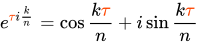
John Conway noted[9] that Euler's identity is a specific case of the general formula of the nth roots of unity, n√1 = eiτk/n (k = 1, 2, ..., n), which he maintained is preferable and more economical than Euler's identity.
Higher-dimensional spheres and balls
[edit]While τ corresponds to the circumference of a unit circle in a two-dimensional plane, the situation is more complicated in higher dimensions, where the formulas for the volume and surface area of a hypersphere in higher-dimensional Euclidean spaces involve fractions and powers of π (or τ).
For a given integer n, the following formulas yield the volume and surface area of a n-dimensional unit hypersphere (in n-dimensional Euclidean space):


or equivalently in terms of τ instead of π:

where is the Euler gamma function and denotes the double factorial.


Comparison of formulas
[edit]The following table shows how various formulas appear when τ = 2π is used instead of π.[31][7] For a more complete list, see List of formulae involving π.
| Formula | Using π | Using τ | Notes |
|---|---|---|---|
| Angle subtended by 1/4 of a circle | τ/4 rad = 1/4 turn | ||
| Circumference of a circle | The length of an arc of angle θ is L = θr. | ||
| Area of a circle | The area of a sector of angle θ is A = 1/2θr2. | ||
| Surface area of a sphere | The area of a spherical surface spanned by the solid angle θ is A = θr2. | ||
| Volume of a 3D ball | The volume of a spherical sector spanned by the solid angle θ is V = 1/3θr3. | ||
| Periodicity of trigonometric and exponential functions |
|
|
Valid for all except in the case, in which case mustn't be in the set |
| Trigonometric formulas for supplementary angles |
|
|
Valid for all except in the case, in which case mustn't be in the set |
| Trigonometric formulas for complementary angles |
|
|
Valid for all except in the case, in which case mustn't be a multiple of |
| Area of a regular n-gon with unit circumradius | |||
| n-ball and n-sphere volume and surface recurrence relation |
|
|
and are (respectively) the hyper-volume and the hyper-surface area of an Euclidean -dimensional hypersphere; V0(r) = 1 S0(r) = 2 |
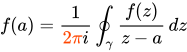
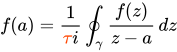
| Cauchy's integral formula | γ is the boundary of a disk containing a in the complex plane. | ||
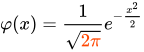
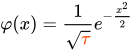
| Standard normal distribution | |||
| Stirling's approximation | |||
| nth roots of unity | |||
| Planck constant | ħ is the reduced Planck constant. | ||
| Angular frequency of a sinusoid | ω is the angular frequency; f is the ordinary frequency; T is the period. | ||
| Riemann's functional equation | reduces to | ||







In culture
[edit]τ has made numerous appearances in culture. It is celebrated annually on June 28, known as Tau Day.[32] Supporters of τ are called tauists.[28] τ has been covered in videos by Vi Hart,[33][34][35] Numberphile,[36][37][38] SciShow,[39] Steve Mould,[40][41][42] Khan Academy,[43] and 3Blue1Brown,[22][44] and it has appeared in the comics xkcd,[45][46] Saturday Morning Breakfast Cereal,[47][48][49] and Sally Forth.[50] The Massachusetts Institute of Technology usually announces admissions on March 14 at 6:28 p.m., which is on Pi Day at Tau Time.[51] Peter Harremoës has used τ in a mathematical research article which was granted the journal Kybernetika's Editor's Award for the year 2016.[52]
In programming languages and calculators
[edit]The following table documents various programming languages that have implemented the circle constant for converting between turns and radians. All of the languages below support the name "Tau" in some casing, but Processing also supports "TWO_PI" and Raku also supports the symbol "τ" for accessing the same value.
| Language | Identifiers | First Version | Year Released |
|---|---|---|---|
| C# / .NET | System.Math.Tau and System.MathF.Tau | 5.0 | 2020 |
| Crystal | TAU | 0.36.0 | 2021 |
| Eiffel | math_constants.Tau | Curtiss | Not yet released |
| Erlang | math:tau/0 | OTP 26.0 | 2023 |
| GDScript | TAU | Godot 3.0 | 2018 |
| Java | Math.TAU | 19 | 2022 |
| Nim | TAU | 0.14.0 | 2016 |
| Processing | TAU and TWO_PI | 2.0 | 2013 |
| Python | math.tau | 3.6 | 2016 |
| Raku | tau and τ | ||
| Rust | core::f64::consts::TAU | 1.47.0 | 2020 |
| Zig | std.math.tau | 0.6.0 | 2019 |
The constant τ is made available in the Google calculator, Desmos graphing calculator,[53] and the iPhone's Convert Angle option expresses the turn as τ.[54]
See also
[edit]- Turn (angle) represents τ radians
- π represents τ/2
Notes
[edit]References
[edit]- 1 2 Hartl, Michael (2019-03-14) [2010-03-14]. "The Tau Manifesto". Archived from the original on 2019-06-28. Retrieved 2013-09-14.
- ↑ "Life of pi in no danger – Experts cold-shoulder campaign to replace with tau". Telegraph India. 2011-06-30. Archived from the original on 2013-07-13. Retrieved 2019-08-05.
- ↑ McMillan, Robert (2020-03-13). "For Math Fans, Nothing Can Spoil Pi Day – Except Maybe Tau Day". Wall Street Journal. ISSN 0099-9660. Retrieved 2020-05-21.
- ↑ "A019692 – OEIS". On-Line Encyclopedia of Integer Sequences. OEIS Foundation Inc. Retrieved 2026-03-19.
- ↑ Hartl, Michael (2010-03-14). "The Tau Manifesto" (PDF). Archived (PDF) from the original on 2019-07-18. Retrieved 2019-08-05.
- ↑ sudgylacmoe; Hartl, Michael (28 June 2023). The Tau Manifesto – With Michael Hartl (YouTube video). Information shown at 18:35. Retrieved 24 July 2024.
- 1 2 Palais, Robert (2001). "Pi is Wrong" (PDF). The Mathematical Intelligencer. 23 (3). New York, USA: Springer-Verlag: 7–8. doi:10.1007/bf03026846. S2CID 120965049. Archived (PDF) from the original on 2019-07-18. Retrieved 2019-08-05.
- 1 2 "Pi Is Wrong!". www.math.utah.edu. Retrieved 2025-04-26.
- 1 2 Crease, Robert (2008-02-01). "Constant failure". Physics World. Institute of Physics. Retrieved 2024-08-03.
- ↑ Cool, Thomas "Colignatus" (2008-07-18) [2008-04-08, 2008-05-06]. "Trig rerigged. Trigonometry reconsidered. Measuring angles in 'unit meter around' and using the unit radius functions Xur and Yur" (PDF). Archived from the original (PDF) on 2023-07-18. Retrieved 2023-07-18. (18 pages)
- ↑ Mann, Steve; Janzen, Ryan E.; Ali, Mir Adnan; Scourboutakos, Pete; Guleria, Nitin (22–24 October 2014). "Integral Kinematics (Time-Integrals of Distance, Energy, etc.) and Integral Kinesiology". Proceedings of the 2014 IEEE GEM. Toronto, Ontario, Canada: 627–629. S2CID 6462220. Retrieved 2023-07-18.
- ↑ Mann, Steve; Chen, Hongyu; Aylward, Graeme; Jorritsma, Megan; Mann, Christina; Defaz Poveda, Diego David; Pierce, Cayden; Lam, Derek; Stairs, Jeremy; Hermandez, Jesse; Li, Qiushi; Xiang, Yi Xin; Kanaan, Georges (June 2019). "Keynote – Eye Itself as a Camera: Sensors, Integrity, and Trust". The 5th ACM Workshop on Wearable Systems and Applications. pp. 1–2. doi:10.1145/3325424.3330210. ISBN 978-1-4503-6775-2. S2CID 189926593. Retrieved 2023-07-18.
- ↑ Al-Kashi, author: Adolf P. Youschkevitch, chief editor: Boris A. Rosenfeld, p. 256
- ↑ "A091649 – OEIS". On-Line Encyclopedia of Integer Sequences. OEIS Foundation Inc. Retrieved 2026-03-19.
- ↑ Beckmann, Petr (1989) [1970]. A History of Pi. Barnes & Noble Publishing.
- ↑ Schwartzman, Steven (1994). The Words of Mathematics: An Etymological Dictionary of Mathematical Terms Used in English. The Mathematical Association of America. p. 165. ISBN 978-0-88385511-9.
- ↑ Euler, Leonhard (1727). "Tentamen explicationis phaenomenorum aeris" (PDF). Commentarii Academiae Scientiarum Imperialis Petropolitana (in Latin). 2: 351. E007. Archived (PDF) from the original on 1 April 2016. Retrieved 15 October 2017.
Sumatur pro ratione radii ad peripheriem, I : π
English translation by Ian Bruce Archived 10 June 2016 at the Wayback Machine: "π is taken for the ratio of the radius to the periphery [note that in this work, Euler's π is double our π.]" - ↑ Euler, Leonhard (1747). Henry, Charles (ed.). Lettres inédites d'Euler à d'Alembert. Bullettino di Bibliografia e di Storia delle Scienze Matematiche e Fisiche (in French). Vol. 19 (published 1886). p. 139. E858.
Car, soit π la circonference d'un cercle, dout le rayon est = 1
English translation in Cajori, Florian (1913). "History of the Exponential and Logarithmic Concepts". The American Mathematical Monthly. 20 (3): 75–84. doi:10.2307/2973441. JSTOR 2973441.Letting π be the circumference (!) of a circle of unit radius
- ↑ Euler, Leonhard (1736). "Ch. 3 Prop. 34 Cor. 1". Mechanica sive motus scientia analytice exposita. (cum tabulis) (in Latin). Vol. 1. Academiae scientiarum Petropoli. p. 113. E015.
Denotet 1 : π rationem diametri ad peripheriam
English translation by Ian Bruce Archived 10 June 2016 at the Wayback Machine : "Let 1 : π denote the ratio of the diameter to the circumference" - ↑ Euler, Leonhard (1922). Leonhardi Euleri opera omnia. 1, Opera mathematica. Volumen VIII, Leonhardi Euleri introductio in analysin infinitorum. Tomus primus / ediderunt Adolf Krazer et Ferdinand Rudio (in Latin). Lipsae: B.G. Teubneri. pp. 133–134. E101. Archived from the original on 16 October 2017. Retrieved 15 October 2017.
- ↑ Euler, Leonhard (1736). Mechanica sive motus scientia analytice exposita. p. 185. Retrieved 2025-02-12.
- 1 2 Sanderson, Grant (2018-03-14). How pi was almost 6.283185... Event occurs at 2:29. Retrieved 2025-02-11.
- ↑ Segner, Johann Andreas von (1761). Cursus Mathematicus: Elementorum Analyseos Infinitorum Elementorum Analyseos Infinitorvm (in Latin). Renger. p. 374.
Si autem π notet peripheriam circuli, cuius diameter eſt 2
- ↑ "Pi". Encyclopaedia Britannica. 2024-03-14. Retrieved 2024-03-26.
- ↑ Euler, Leonhard (1746). Nova theoria lucis et colorum. Opuscula varii argumenti (in Latin). sumtibus Ambr. Haude & Jo. Carol. Speneri, bibliop. p. 200.
unde constat punctum B per datum tantum spatium de loco fuo naturali depelli, ad quam maximam distantiam pertinget, elapso tempore t = π/m denotante π angulum 180°, quo fit cos(m t) = −1 & B b = 2 α.
[from which it is clear that the point B is pushed by a given distance from its natural position, and it will reach the maximum distance after the elapsed time t = π/m, π denoting an angle of 180°, which becomes cos(m t) = −1 & B b = 2 α.] - ↑ Aron, Jacob (2011-01-08). "Michael Hartl: It's time to kill off pi". New Scientist. 209 (2794): 23. Bibcode:2011NewSc.209...23A. doi:10.1016/S0262-4079(11)60036-5.
- ↑ Landau, Elizabeth (2011-03-14). "On Pi Day, is 'pi' under attack?". cnn.com. CNN. Archived from the original on 2018-12-19. Retrieved 2019-08-05.
- 1 2 Bartholomew, Randyn Charles (2014-06-25). "Let's Use Tau – It's Easier Than Pi – A growing movement argues that killing pi would make mathematics simpler, easier and even more beautiful". Scientific American. Archived from the original on 2019-06-18. Retrieved 2015-03-20.
- ↑ Butler, David. "Pi, Tau and Eta". Archived from the original on 2025-04-17.
- ↑ Peshin, Akash (2017-12-24). "Euler's Identity: 'The Most Beautiful Theorem In Mathematics'". ScienceABC. Retrieved 2025-04-27.
- ↑ Abbott, Stephen (April 2012). "My Conversion to Tauism" (PDF). Math Horizons. 19 (4): 34. doi:10.4169/mathhorizons.19.4.34. S2CID 126179022. Archived (PDF) from the original on 2013-09-28.
- ↑ Hartl, Michael. "Tau Day". Retrieved 1 November 2024.
- ↑ Hart, Vi (14 March 2011). "Pi is (still) Wrong". YouTube. Retrieved 1 November 2024.
- ↑ Hart, Vi (28 June 2012). "A Song About A Circle Constant". YouTube. Retrieved 1 November 2024.
- ↑ Hart, Vi (28 June 2015). "360 Video for Tau Day". YouTube. Retrieved 1 November 2024.
- ↑ Haran, Brady; Moriarty, Phil (9 November 2012). "Tau replaces Pi – Numberphile". YouTube. Retrieved 1 November 2024.
- ↑ Haran, Brady; Moriarty, Phil (19 November 2012). "Tau of Phi – Numberphile". YouTube. Retrieved 1 November 2024.
- ↑ Haran, Brady; Mould, Steve; Parker, Matthew (14 December 2012). "Tau vs Pi Smackdown – Numberphile". YouTube. Retrieved 1 November 2024.
- ↑ Hofmeister, Caitlin (26 June 2015). "Happy Tau Day!". YouTube. Retrieved 1 November 2024.
- ↑ Mould, Steve (2018-11-06). Stand-up comedy routine about bad science. Event occurs at 10:31. Retrieved 2024-11-17.
- ↑ Mould, Steve (2023-11-06). A cast saw on human skin. Event occurs at 7:22. Retrieved 2024-11-13.
- ↑ Mould, Steve (2024-03-14). world record calculation of tau by hand. Retrieved 2024-11-13.
- ↑ Khan, Sal (2011-07-11). Tau versus pi | Graphs of trig functions | Trigonometry | Khan Academy. Retrieved 2024-11-24.
- ↑ Sanderson, Grant (2019-07-07). e^(iπ) in 3.14 minutes, using dynamics | DE5. Event occurs at 3:08. Retrieved 2024-11-24.
- ↑ Munroe, Randall. "Pi vs. Tau". xkcd. Retrieved 1 November 2024.
- ↑ Munroe, Randall. "Symbols". xkcd. Retrieved 1 November 2024.
- ↑ Weinersmith, Zachary. "Fresh". Saturday Morning Breakfast Cereal. Retrieved 2 November 2024.
- ↑ Weinersmith, Zachary. "Better than Pi". Saturday Morning Breakfast Cereal. Retrieved 2 November 2024.
- ↑ Weinersmith, Zachary. "Social". Saturday Morning Breakfast Cereal. Retrieved 2 November 2024.
- ↑ Marciuliano, Francesco. "Sally Forth Comic Strip 2018-10-13". Comics Kingdom. Retrieved 13 November 2024.
- ↑ "Fun & Culture – MIT Facts". Massachusetts Institute of Technology. Retrieved 2 November 2024.
- ↑ Harremoës, Peter (2017). "Bounds on tail probabilities for negative binomial distributions". Kybernetika. 52 (6): 943–966. arXiv:1601.05179. doi:10.14736/kyb-2016-6-0943. S2CID 119126029.
- ↑ "Supported Functions". help.desmos.com. Archived from the original on 2023-03-26. Retrieved 2023-03-21.
- ↑ Naumovski, Jovana (2022-08-05). "iOS 16 Has a Hidden Unit Converter for Temperatures, Time Zones, Distance, and Other Measurements". Gadget Hacks. Retrieved 21 October 2024.