


// Workers AI · dad joke modeWhat did 1177 B.C. say to 1176 B.C.? You're a year behind.
 Cover of the first edition | |
| Author | Eric H. Cline |
|---|---|
| Audio read by | Andy Caploe |
| Language | English |
| Series | Turning Points in Ancient History |
| Subject | Late Bronze Age collapse |
| Publisher | Princeton University Press |
| Publication date | 2014 |
| Publication place | United States |
| Media type | Print, e-book, audio book |
| Pages | 264 |
| Awards | 2014 The New York Post's Best Books. 2014 The Australian's Best Books of the Year. 2015 The Federalist's Notable Books. |
| ISBN | 9780691140896 |
| Dewey Decimal | 930.1'56-dc23 |
| LC Class | GN778.25.C55 2014 https://lccn.loc.gov/2013032059 |
| Website | Publisher - 1177 B.C |
1177 B.C.: The Year Civilization Collapsed is a 2014 non-fiction book about the Late Bronze Age collapse by American archaeologist Eric H. Cline. It was published by Princeton University Press. An updated edition was published in 2021.
Description
[edit]The book focuses on Cline's hypothesis for the Late Bronze Age collapse of civilization, a transition period that affected the Egyptians, Hittites, Canaanites, Cypriots, Minoans, Mycenaeans, Assyrians and Babylonians; varied heterogeneous cultures populating eight powerful and flourishing states intermingling via trade, commerce, exchange and "cultural piggybacking," despite "all the difficulties of travel and time".[1] He presents evidence to support a "perfect storm" of "multiple interconnected failures," meaning that more than one natural and man-made cataclysm caused the disintegration and demise of an ancient civilization that incorporated "empires and globalized peoples."[1][2] This ended the Bronze Age, and ended the Mycenaean, Minoan, Trojan, Hittite, and Babylonian cultures.[2]
Before this book, the leading hypothesis during previous decades attributed the civilizations' collapse mostly to Sea Peoples of unknown origin.[1][2][3][4]
Awards
[edit]The book has won the following awards:[2]
- Winner of the 2014 Award for the Best Popular Book, American Schools of Oriental Research
- Honorable Mention for the 2015 PROSE Award in Archeology & Anthropology, Association of American Publishers
- One of The New York Post's Best Books of 2014
- One of The Federalist's Notable Books of 2015
- One of The Australian's Best Books of the Year in 2014, chosen by filmmaker Bruce Beresford
- Selected as the 'Book of the Semester' Fall 2016, David M. Kennedy Center for International Studies at Brigham Young University
See also
[edit]References
[edit]- 1 2 3 Gopnik, Adam (19 March 2014). "Of Hippos and Kings". New Yorker. Condé Nast. Retrieved 5 July 2017.
- 1 2 3 4 Summary (2014). "1177 B.C.: The Year Civilization Collapsed, Eric H. Cline". Princeton University Press. Archived from the original on 2017-07-19. Retrieved 7 July 2017.
- ↑ Knapp, A. Bernard. "The Year Civilization Collapsed". History Today. Archived from the original on 2017-07-19.
- ↑ Karacic, Steven (August 2015). "Eric H. Cline, 1177 B.C.: The Year Civilization Collapsed". Bryn Mawr Classical Review (BMCR). Bryn Mawr College. Retrieved 5 July 2017.
Further reading
[edit]- Cline, Eric H. (27 May 2014). "Climate Change Doomed the Ancients". The New York Times. Retrieved 3 July 2017.
- Knapp, A.; Manning, S. (January 2016). "End of the Late Bronze Age in the Eastern Mediterranean". American Journal of Archaeology. 120 (1): 99–149 (51 pages). doi:10.3764/aja.120.1.0099. JSTOR 10.3764/aja.120.1.0099.
- Book review: Warford, Erin (17 Mar 2017). "1177 B.C. - The Year Civilization Collapsed". The European Legacy. 22 (5). Taylor & Francis: 634–636. doi:10.1080/10848770.2017.1304058. S2CID 151497133.
- Book review: Hall, Thomas D. (Free PDF download) (2014). "A "Perfect Storm" in the Collapse of Bronze Age Civilization? Useful Insights and Roads not Taken" (PDF). Cliodynamics: The Journal of Quantitative History and Cultural Evolution. 5 (1): 1–12. doi:10.21237/C7clio5125316. University of California (publisher).
- Book review: Kotsonas, Antonis (2015). "E.H. Cline 1177 B.C. The Year Civilization Collapsed...". The Classical Review. 65 (2): 611–612. doi:10.1017/S0009840X15000128. S2CID 165120439.
External links
[edit]- ISBN 978-0-691-14089-6
- Publisher's site for this book
- Professor Cline's video lecture on his book.
- Full text of this book available on JSTOR

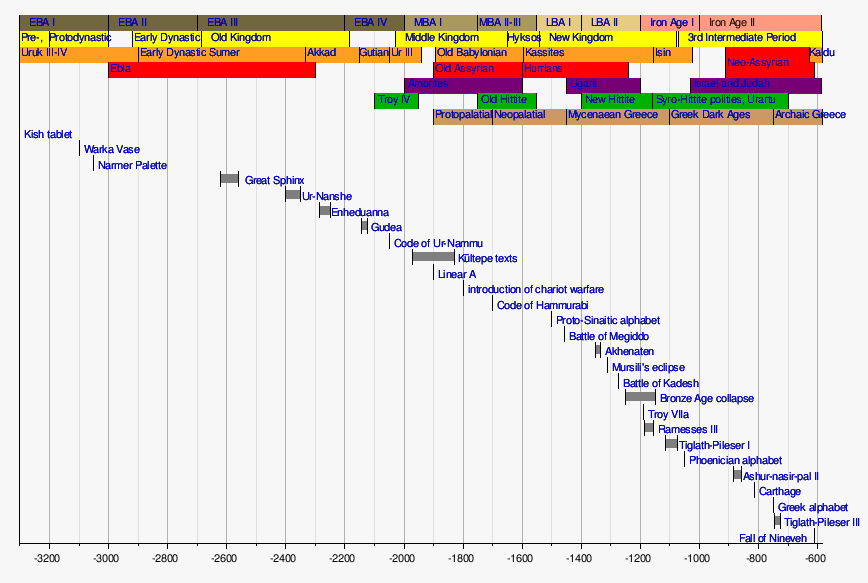
Timeline of the ancient Near East | |
|---|---|
 | |

- 12th century BC in Egypt
- 2014 non-fiction books
- 2014 English-language non-fiction books
- 21st-century history books
- American non-fiction books
- Bronze Age cultures
- History books about the 12th century BC
- History books about the Trojan War
- Mycenaean Greece
- Prehistoric Asia
- Princeton University Press books
- Works about societal collapse