


// Workers AI · dad joke modeWhat did (−1)F say to its date? "You're negatively attractive.
 | This article includes a list of general references but lacks sufficient corresponding inline citations. (February 2013) |
| Part of a series of articles about |
| Quantum mechanics |
|---|
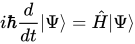
In a quantum field theory with fermions, (−1)F is a unitary, Hermitian, involutive operator where F is the fermion number operator. For the example of particles in the Standard Model, it is equal to the sum of the lepton number plus the baryon number, F = B + L. The action of this operator is to multiply bosonic states by 1 and fermionic states by −1. This is always a global internal symmetry of any quantum field theory with fermions and corresponds to a rotation by 2π. This splits the Hilbert space into two superselection sectors. Bosonic operators commute with (−1)F whereas fermionic operators anticommute with it.[1]
This operator really shows its utility in supersymmetric theories.[1] Its trace is the spectral asymmetry of the fermion spectrum, and can be understood physically as the Casimir effect.
See also
[edit]References
[edit]- 1 2 Terning, John (2006). Modern Supersymmetry:Dynamics and Duality: Dynamics and Duality. New York: Oxford University Press. ISBN 0-19-856763-4.
Further reading
[edit]- Shifman, Mikhail A. (2012). Advanced Topics in Quantum Field Theory: A Lecture Course. Cambridge: Cambridge University Press. ISBN 978-0-521-19084-8.
- Ibáñez, Luis E.; Uranga, Angel M. (2012). String Theory and Particle Physics: An Introduction to String Phenomenology. Cambridge: Cambridge University Press. ISBN 978-0-521-51752-2.
- Bastianelli, Fiorenzo (2006). Path Integrals and Anomalies in Curved Space. Cambridge: Cambridge University Press. ISBN 978-0-521-84761-2.